Blog
In a field that evolves daily, staying ahead means staying informed.
Explore in-depth articles designed to help you solve complex challenges,
maximize your machine’s ROI.
Stay ahead in a competitive market.

In a field that evolves daily, staying ahead means staying informed.
Explore in-depth articles designed to help you solve complex challenges,
maximize your machine’s ROI.
Stay ahead in a competitive market.
News | Sep-4-2026
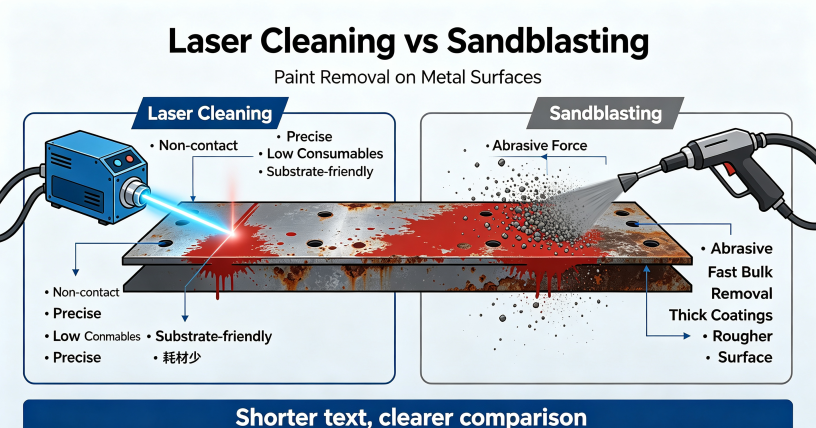
Removing paint from metal surfaces is a common requirement in automotive manufacturing, metal fabrication, equipment maintenance, restoration, and surface preparation. For decades, sandblasting has been one of the most widely used methods for removing paint, rust, and other surface contaminants.
However, laser cleaning has introduced a different approach. Instead of using abrasive media to mechanically strip a surface, a laser cleaning machine uses focused laser energy to selectively remove paint, rust, oxides, oil, and other contaminants.
So, when comparing laser cleaning for paint removal vs. sandblasting, which method is better?
The answer depends on the material, coating thickness, cleaning area, required precision, and production environment. Sandblasting can remain effective for heavy-duty bulk removal, while laser cleaning provides a non-contact and more controlled solution for applications where surface preservation and reduced consumables are important.
Laser cleaning uses concentrated laser energy to interact with the unwanted material on a surface. When the laser is correctly matched to the contaminant and substrate, the coating absorbs the laser energy and is removed through a combination of thermal effects and ablation.
Unlike sandblasting, the laser does not rely on abrasive particles hitting the workpiece.
For paint removal, the process generally involves:
The actual cleaning result depends on factors such as laser power, scanning speed, material type, paint composition, coating thickness, and parameter settings.
This is why laser cleaning should not be treated as a single fixed process for every material or coating.
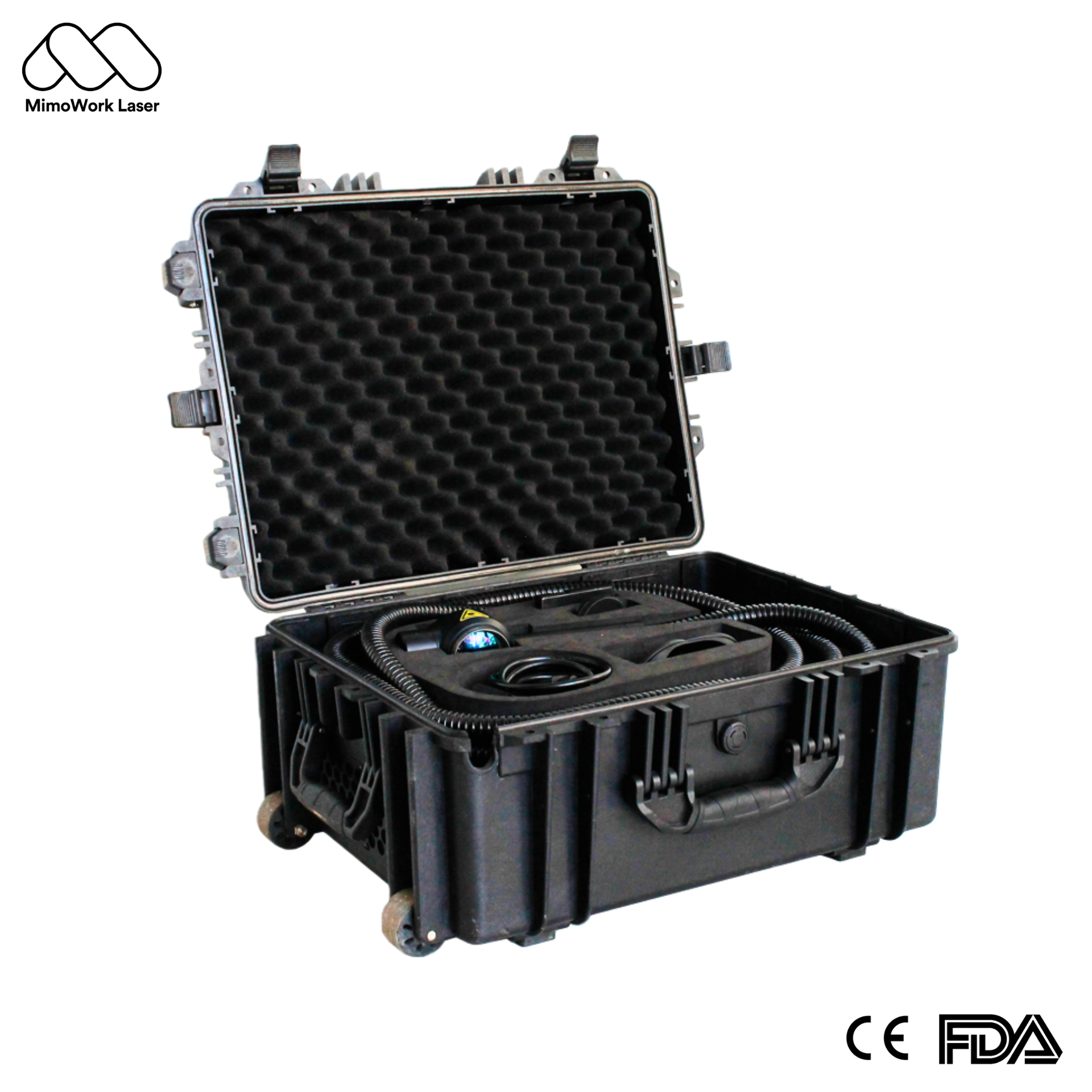
MimoWork’s laser cleaning solutions include both pulsed fiber laser cleaning and continuous wave (CW) laser cleaning, with each configuration suited to different cleaning requirements.
MimoWork’s Pulsed Laser Cleaning Machine is available in 100–500W configurations and is designed for precision cleaning where surface integrity is particularly important.
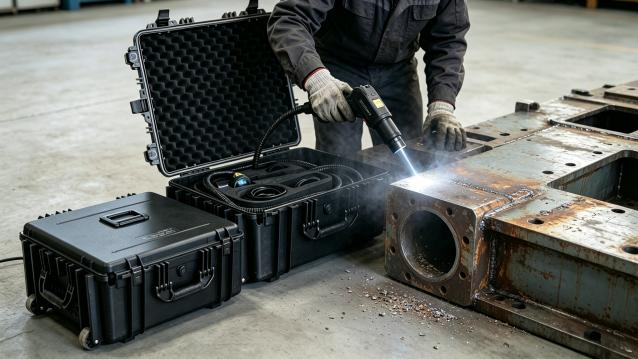
The short, high-peak-power pulses allow operators to control energy delivery more precisely. This makes pulsed laser cleaning suitable for applications such as:
Pulsed systems are particularly useful when the goal is to remove a surface layer while minimizing unnecessary heat input into the underlying material.
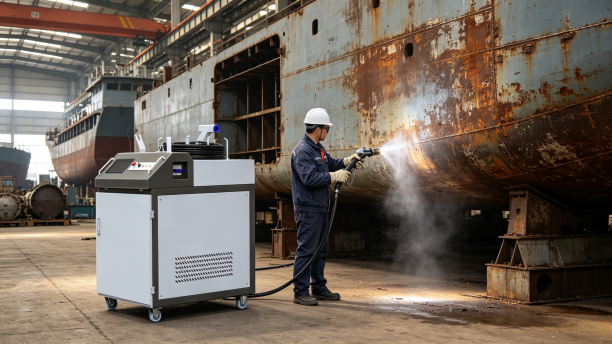
For larger surfaces and heavier contamination, continuous wave laser cleaning provides a different advantage.
MimoWork’s current industrial CW laser cleaning solutions extend from 1000W to 3000W, targeting high-productivity applications involving rust, paint, oxides, and other contaminants on large metal surfaces.
CW laser cleaning is especially relevant for:
The higher continuous output makes CW systems better suited to applications where cleaning speed and coverage are more important than ultra-fine surface control.
The biggest difference between the two technologies is the way they remove contaminants.
Sandblasting accelerates abrasive media toward the workpiece at high speed. The physical impact breaks down and removes paint, rust, corrosion, and other surface materials.
This makes abrasive blasting effective for heavy-duty surface preparation, especially when large amounts of material need to be removed quickly.
However, the abrasive media can also modify the surface profile. Depending on the material and blasting conditions, excessive mechanical impact may affect thin or delicate components.
Sandblasting also requires continuous management of abrasive media, dust, and spent material.
Laser cleaning is a non-contact process. Instead of mechanically striking the workpiece, the laser interacts with the contaminant layer using controlled optical energy.
This provides several advantages when surface preservation is important:
However, laser cleaning is not automatically the best choice for every job. The laser configuration must match the material, contaminant, cleaning area, and required productivity.
The following comparison provides a practical overview of the two technologies:
| Feature | Laser Cleaning | Sandblasting |
| Removal method | Laser ablation and thermal effects | Mechanical abrasive impact |
| Contact with workpiece | Non-contact | Direct particle impact |
| Abrasive media | Not required | Required |
| Paint removal | Yes, with suitable parameters | Yes |
| Rust removal | Yes | Yes |
| Oxide removal | Yes | Yes |
| Surface control | High | Lower |
| Media waste | No spent abrasive media | Generates spent abrasive media |
| Dust generation | Fine particles and fumes require extraction | Significant dust and spent media |
| Surface profile | Can preserve the original surface when properly parameterized | Can roughen or modify the surface |
| Automation | Suitable for automated systems | Automation is possible but requires dedicated blasting equipment |
| Best suited for | Precision cleaning and controlled industrial cleaning | Heavy-duty bulk removal |
The comparison shows that the question is not simply whether laser cleaning is better than sandblasting.
Instead, the better technology depends on the specific cleaning task.
One of the main advantages of laser paint removal is that the laser does not physically touch the workpiece.
This can be valuable when cleaning components where mechanical abrasion may affect edges, dimensions, or surface conditions.
For precision applications, MimoWork’s pulsed laser cleaning systems are designed to provide controlled cleaning with a focus on preserving the underlying material.
Laser cleaning does not require the continuous supply of abrasive materials used by traditional sandblasting.
This can simplify the cleaning workflow by eliminating the need to purchase, transport, store, and replenish blasting media.
MimoWork specifically positions laser cleaning as a consumable-free alternative to abrasive cleaning for metal surface preparation.
Sandblasting produces both removed coating material and spent abrasive media.
Laser cleaning eliminates the spent abrasive media component. The paint, rust, and other contaminants removed by the laser still generate particles and fumes, so an appropriate extraction system remains important.
This distinction is important: laser cleaning reduces the waste associated with abrasive media, but it does not mean that the cleaning process produces no particles at all.
Laser parameters can be adjusted according to the material and contaminant.
Power, scanning speed, frequency, and other settings influence how the laser interacts with the surface.
This level of digital control is particularly useful when cleaning sensitive parts or removing specific surface layers.
Laser cleaning can be integrated into automated production environments.
Depending on the application, laser cleaning systems can be combined with automated motion systems or robotic equipment for repeatable cleaning operations.
This makes laser cleaning suitable not only for handheld maintenance work but also for industrial production and surface preparation processes.
Despite the advantages of laser cleaning, sandblasting should not be dismissed.
For extremely large surfaces covered with thick coatings, heavy corrosion, or substantial contamination, abrasive blasting can provide fast bulk removal.
Sandblasting may therefore remain practical for:
The main limitation is that the abrasive process also affects the surface profile and creates spent media that must be collected and managed.
For this reason, sandblasting and laser cleaning should be considered different tools rather than direct replacements in every application.
The appropriate laser cleaning machine depends mainly on the cleaning requirement.If you’re comparing different laser cleaning systems, our laser cleaning machine buying guide provides a more detailed overview of the key factors to consider before choosing a machine.
A pulsed laser cleaning machine is generally more suitable when:
MimoWork’s pulsed systems use 100–500W pulsed fiber lasers for precision cleaning applications.
A continuous wave laser cleaning machine is more appropriate when:
MimoWork’s CW laser cleaning systems currently cover 1000–3000W configurations for heavy-duty cleaning applications.
Laser paint removal can be used across a wide range of industrial applications.
Laser cleaning can remove paint, oxide layers, oil, and other contaminants from automotive components.
It can also be used for surface preparation before welding, coating, or other manufacturing processes.
Aerospace components often require controlled surface treatment because excessive mechanical abrasion can be undesirable.
Pulsed laser cleaning can provide a more controlled approach to removing coatings and contaminants from suitable aerospace parts.
Metal fabrication operations can use laser cleaning to remove:
Cleaning the surface before welding or coating can help prepare the material for subsequent manufacturing processes.
Molds and tooling can accumulate residues, release agents, carbon deposits, and other contaminants during production.
Precision laser cleaning can remove these contaminants without relying on abrasive media, making it suitable for applications where maintaining surface accuracy is important.
Large metal components and structures can benefit from high-power CW laser cleaning when removing rust, paint, and other heavy contamination over larger areas.
This is one of the areas where the higher productivity of continuous wave laser systems becomes particularly valuable.
Laser paint removal should always be performed with appropriate safety controls.
The laser beam itself requires suitable laser safety measures, while the removal of paint and coatings generates smoke and fine particulate matter.
A complete laser cleaning setup should therefore consider:
MimoWork’s technical guidance specifically recommends dedicated fume extraction because laser cleaning can generate dense smoke and fine particles during the removal process.
The correct extraction configuration should be selected according to the material, contaminant, cleaning process, and working environment.
There is no universal winner between laser cleaning and sandblasting.
Sandblasting is still a practical choice for heavy-duty bulk removal, especially when large surfaces require aggressive material removal or surface roughening.
Laser cleaning is a better fit when non-contact processing, surface control, reduced abrasive waste, and precise cleaning are more important.
For precision paint removal, MimoWork’s 100–500W pulsed fiber laser cleaning machines provide controlled cleaning for applications involving sensitive components, molds, automotive parts, aerospace components, and coatings.
For large-area and heavy-duty cleaning, MimoWork’s 1000–3000W CW laser cleaning machines provide higher continuous output for rust, paint, oxides, and other contaminants on large metal surfaces.
The best solution should therefore be selected according to the material, paint or contaminant, coating thickness, cleaning area, required speed, and surface preservation requirements rather than laser power alone.
Yes. Laser cleaning machines can remove paint and other surface coatings when the laser power and cleaning parameters are properly matched to the material and coating. MimoWork’s pulsed laser cleaning systems are specifically designed for precision coating removal.
It depends on the application. Laser cleaning is advantageous when non-contact processing, controlled surface treatment, and reduced abrasive waste are important. Sandblasting can be more practical for heavy-duty bulk removal and applications where surface roughening is acceptable.
There is no single power level for every paint removal application. MimoWork offers 100–500W pulsed laser cleaning systems for precision cleaning and 1000–3000W CW systems for larger and heavier industrial cleaning applications.
When appropriate laser parameters are selected, laser cleaning can selectively remove contaminants while minimizing the impact on the underlying material. However, the result depends on the laser configuration, material, coating, and processing parameters, so application testing is recommended before production.
Yes, appropriate fume extraction should be considered because removing paint and coatings generates smoke and fine particles. A suitable extraction and filtration system helps maintain a cleaner and safer working environment.
Laser cleaning has become an important alternative to traditional surface preparation methods such as sandblasting and chemical stripping.
For paint removal, its biggest advantages are non-contact processing, controlled energy delivery, no abrasive media, reduced secondary waste, and the ability to handle both precision and industrial cleaning applications with different laser configurations.
However, sandblasting remains useful for heavy-duty bulk removal and surface roughening. The right choice depends on the workpiece, coating, cleaning area, productivity requirements, and desired surface condition.
For businesses evaluating laser paint removal equipment, the most important step is not simply choosing the highest-power machine. Instead, the laser source, power, cleaning method, and system configuration should be matched to the actual application.
MimoWork provides both pulsed and continuous wave laser cleaning solutions for different industrial surface preparation requirements, helping manufacturers select a cleaning system based on their materials, workflow, and production goals.
News | Aug-6-2026