Blog
In a field that evolves daily, staying ahead means staying informed.
Explore in-depth articles designed to help you solve complex challenges,
maximize your machine’s ROI.
Stay ahead in a competitive market.


In a field that evolves daily, staying ahead means staying informed.
Explore in-depth articles designed to help you solve complex challenges,
maximize your machine’s ROI.
Stay ahead in a competitive market.
News | Nov-20-2026 | Mimowork
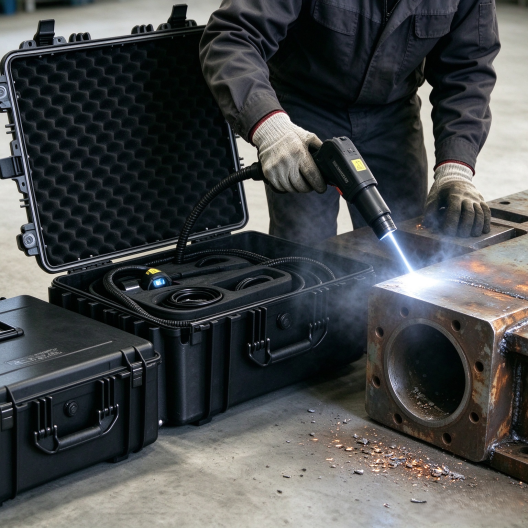
Yes, a 100W laser cleaning machine can replace sandblasting or dry ice cleaning for certain applications—but not every one.
Its advantage is not raw cleaning force. It is controlled removal. A 100W pulsed laser can remove surface rust, oxide, paint, oil, and similar contaminants while minimizing contact with the underlying material.
That makes it attractive for precision parts, visible metal surfaces, pre-weld cleaning, and jobs where abrasive media creates more problems than it solves.
For thick coatings, heavy corrosion, or very large surfaces, however, 100W may be too slow. In those cases, sandblasting or a higher-power laser can make more economic sense.
Yes—when the job is surface cleaning rather than aggressive material removal.
Sandblasting works by physically impacting the workpiece with abrasive media. That is exactly why it is so effective at stripping stubborn coatings and heavy contamination. But the same force can alter the surface texture, create secondary waste, and make it difficult to clean only a specific area.
Laser cleaning takes a different approach. A pulsed laser delivers concentrated energy to the contaminated layer. With suitable parameters, the unwanted material can be removed while limiting the effect on the substrate.
That difference matters when the part underneath is expensive or dimensionally sensitive.
A precision metal component with light oxidation may not need an abrasive process at all. A thick layer of industrial coating on a large steel structure is a completely different problem.
So, the better question is not “Can 100W replace sandblasting?”
It is:
“Do I need aggressive stripping, or do I need controlled cleaning?”
If the second answer describes your application, 100W becomes much more interesting.
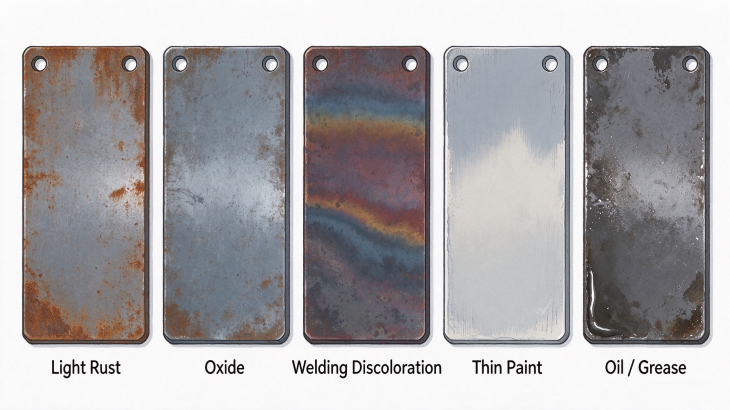
A 100W pulsed system is particularly suited to relatively light or moderate surface contamination.
Rust and oxide layers are common applications because the laser can target the unwanted surface layer without mechanical contact. Paint, grease, oil, and welding discoloration can also be suitable depending on their thickness and composition.
| Application | 100W suitability | Main limitation |
| Light rust | Excellent | Cleaning area per minute |
| Oxide removal | Excellent | Surface requirements |
| Welding discoloration | Excellent | Required finish |
| Oil / grease | Good | Contamination thickness |
| Thin paint | Good | Coating composition |
| Heavy rust scale | Application-dependent | May require multiple passes |
| Thick industrial coating | Limited | Removal rate |
| Large-area stripping | Often inefficient | Processing speed |
The important variable is not simply whether the material is “rust” or “paint.”
Thickness matters.
Removing a thin oxide film from a metal component and removing a thick industrial coating may both be called “cleaning,” but the production economics are completely different.
Laser cleaning has a stronger case when you need precision and do not want blasting media. Dry ice remains attractive when you need fast, non-abrasive cleaning across larger areas.
Dry ice cleaning uses CO₂ pellets accelerated toward the surface. The pellets help detach contamination and then sublimate, so there is no conventional abrasive media left behind.
Laser cleaning eliminates blasting media altogether, but it does not eliminate the need for extraction. Removed coatings, rust, and contaminants still become airborne particles that must be properly captured.
The practical differences are clearer here:
| Factor | 100W Laser Cleaning | Dry Ice Cleaning | Sandblasting |
| Contact with workpiece | No | Indirect impact | Abrasive impact |
| Abrasive media | None | Dry ice | Required |
| Precision | High | Moderate | Lower |
| Heavy stripping | Limited | Moderate | Strong |
| Surface control | Excellent | Good | More aggressive |
| Secondary media waste | None | Minimal | Significant |
| Best fit | Precision cleaning | Broad non-abrasive cleaning | Aggressive stripping |
There is no universal winner.
A laser is attractive when protecting the substrate and controlling the cleaning area are important. Dry ice can be practical when the surface is large and contamination is relatively easy to remove. Sandblasting remains difficult to beat when maximum removal rate is the priority.
For light-to-moderate rust, often yes. For heavy corrosion, the question becomes processing time.
This is where buyers sometimes make a mistake.
A laser may successfully remove heavy rust, but that does not necessarily make it a good production solution. If the machine needs several passes to clean each component, the process can become slower and more expensive than expected.
For example, a repair shop cleaning a few precision components each day may be perfectly happy with a 100W system.
A manufacturer cleaning hundreds of large parts every shift may need considerably more power.
The right measurement is therefore not simply whether the rust disappears.
Measure how many square centimeters of acceptable surface can be cleaned per minute.
That figure lets you compare a 100W machine with your current process using real production numbers.
A 100W machine is probably not the best starting point when the main objective is high-speed removal of thick material over a large surface.
Suppose a manufacturer needs to strip a heavy industrial coating from several square meters of steel every day. The laser may technically be capable of removing it, but the processing time could make the economics unattractive.
In that situation, a higher-power laser or abrasive process may be more appropriate.
The opposite is true for a precision component where the substrate must remain largely unchanged. Here, the slower but more controlled nature of a 100W pulsed laser can be an advantage.
This is why higher wattage does not automatically mean better cleaning.
Power should be selected according to contamination thickness, surface area, required cleaning rate, and acceptable substrate effect.
For many precision applications, pulsed laser cleaning is a strong option because energy can be delivered in short bursts rather than as continuous heating.
That allows the process to target the contamination while limiting unnecessary heat accumulation.
MimoWork offers pulsed laser cleaning systems for applications such as rust, paint, oxide, and oil removal. Its cleaning solutions cover different power levels, allowing the system to be selected according to the required removal rate rather than treating 100W as a universal specification.
For buyers comparing machines, look beyond the wattage. Pulse characteristics, scanning system, focal control, extraction, and actual sample performance can have a major effect on the final result.
Test your own contaminated part—not a clean piece of demonstration metal.
A useful test should answer three questions.
First, how quickly does the machine achieve the required cleaning result?
Second, what does the substrate look like afterward?
Third, is the result consistent across multiple parts?
For example, removing rust before repainting has different requirements from cleaning a visible stainless-steel surface. In the first case, the goal may simply be sufficient surface preparation. In the second, discoloration or surface texture changes may be unacceptable.
MimoWork provides application testing and configuration support for laser cleaning applications. A material test using your actual contamination is the most reliable way to determine whether 100W is sufficient or whether a higher-power configuration would provide a better production rate.
Related guide: 100W Laser Cleaning Machine: The Precision Solution for Mold & Rust Removal
Yes. A 100W pulsed laser can be suitable for light and moderate rust removal. Heavy corrosion may require more passes or a higher-power system.
Not universally. It can replace sandblasting in precision cleaning and selected coating-removal applications, but abrasive blasting remains more suitable for some heavy-duty stripping jobs.
It depends on the application. Laser cleaning provides greater selectivity and requires no blasting media. Dry ice can be more practical for certain large-area, non-abrasive cleaning tasks.
A properly optimized process can minimize substrate damage, but unsuitable parameters can still affect the surface. Actual material testing is essential for sensitive components.
Choose according to the required cleaning rate. A 100W system can be ideal for precision and moderate contamination; higher power becomes more attractive when large areas or heavy contamination need to be processed quickly.
A 100W laser cleaning machine makes sense when the value of controlled cleaning is greater than the need for brute-force removal.
That is where it can outperform the logic of traditional blasting.
You are not buying 100W simply to remove rust faster. You are buying a different cleaning process—one that can remove contamination without abrasive media, reduce manual handling, and give you much more control over the surface.
But there is a clear limit.
If your production depends on stripping thick coatings from large areas as quickly as possible, 100W may not be the right tool.
Before buying, test the actual part and measure cleaning time per unit area. That number—not the wattage printed on the machine—will tell you whether 100W is the right investment.
If you are currently using sandblasting or dry ice, send MimoWork your material, contamination type, approximate thickness, and current cleaning time. A sample test can show whether a 100W system is sufficient or whether a higher-power configuration would make more sense for your production.
News | Sep-24-2026
News | Aug-6-2026