Blog
In a field that evolves daily, staying ahead means staying informed.
Explore in-depth articles designed to help you solve complex challenges,
maximize your machine’s ROI.
Stay ahead in a competitive market.


In a field that evolves daily, staying ahead means staying informed.
Explore in-depth articles designed to help you solve complex challenges,
maximize your machine’s ROI.
Stay ahead in a competitive market.
News | Nov-1-2026 | Mimowork
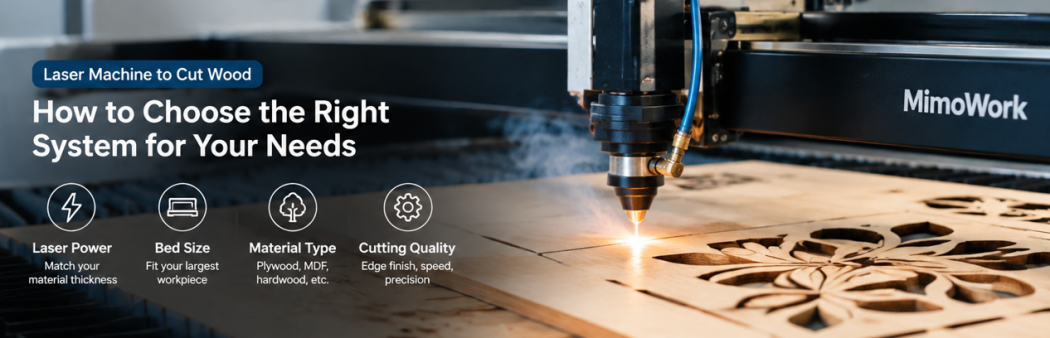
A laser machine to cut wood should match your material thickness, production volume, required edge quality, and workpiece dimensions. For most industrial wood-cutting applications, a CO2 laser cutting machine is a practical starting point because it processes many wood-based materials without mechanical contact. However, choosing the right system requires more than comparing laser power. Bed size, material composition, exhaust capacity, and cutting parameters all influence production results.
This guide explains how to select an industrial wood laser cutter, compare key configurations, and determine which MimoWork system may fit your manufacturing needs.
A CO2 laser cutting machine for wood is generally the preferred option for cutting wood, plywood, MDF, and other non-metallic sheet materials. The best configuration depends on the material, thickness, cutting speed, and required working area.
CO2 lasers operate at a wavelength of approximately 10.6 μm, which is readily absorbed by wood and many other organic materials. The concentrated laser energy heats and vaporizes material along the cutting path, creating narrow cuts without a mechanical blade.
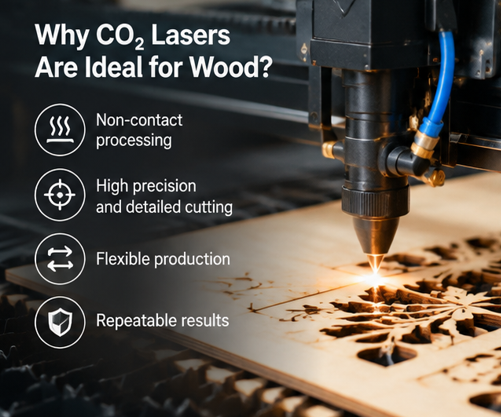
CO2 laser cutters are commonly used for plywood components, wooden packaging, decorative panels, signage, model-making parts, and furniture details.
Wood is combustible, however, and laser cutting can produce charred edges or ignite material under unsuitable conditions. Effective extraction, appropriate air assist, parameter testing, and operator supervision are essential.
CO2 and fiber lasers serve different processing needs. For conventional wood cutting, CO2 is generally the more suitable technology.
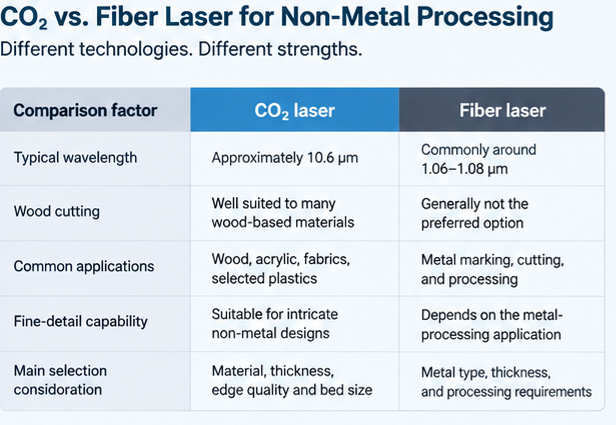
Fiber lasers are widely used for metals because of their interaction with metallic materials. They are not a direct substitute for CO2 systems when wood cutting is the primary task.
Choose laser power according to the thickness and composition of your wood, while selecting the worktable according to your largest workpiece and production layout. Neither parameter should be considered in isolation.
When evaluating CO2 laser power for wood cutting, consider material thickness, density, moisture, resin content, adhesive composition, focus, and cutting speed. Higher laser power can support thicker-material cutting or faster processing under suitable conditions, but it does not guarantee a particular result.
The following table provides an initial selection framework rather than a guaranteed thickness rating.
| CO2 laser power | Potential applications | What to evaluate |
| 60–100W | Thin wood sheets, small components, detailed cutting | Edge quality, cutting speed, and material consistency |
| 100–150W | General production involving wood panels and plywood | Required thickness, throughput, and cut quality |
| 150–300W | Higher-throughput production and more demanding cutting tasks | Material testing, cooling, extraction, and operating costs |
| 300–600W | Selected heavy-duty industrial applications | Verified cutting requirements, machine configuration, and production economics |
Before specifying a machine, test representative samples at the intended thickness. Compare cutting speed, edge discoloration, kerf width, dimensional accuracy, and the percentage of parts that meet quality requirements.
The industrial laser cutter bed size should accommodate the largest panel, cutting layout, and any loading or positioning requirements. A larger bed can reduce material repositioning and support more efficient batch processing, but it also requires sufficient floor space and appropriate material handling.
| Working area | Suitable production considerations |
| 600 × 400 mm | Small components, prototypes, and compact workpieces |
| 1300 × 900 mm | Medium-sized panels and general workshop production |
| 1600 × 1000 mm | Larger components and expanded nesting layouts |
| 1300 × 2500 mm | Large-format sheet processing and selected 4 × 8 ft panel workflows |
MimoWork’s F130-L has a 1300 × 2500 mm working area and supports specified CO2 laser power configurations from 100W to 600W. This format may suit manufacturers processing large panels, provided the available area and selected configuration meet their production requirements.
Wood species, density, moisture, grain direction, and manufactured-board composition all affect cutting behavior. Test the actual material rather than relying on a generic setting for every type of wood.
Softwoods, such as pine and cedar, generally have lower density than many hardwoods, although substantial variation exists between species and individual boards. Hardwoods such as oak and maple may require different power and speed combinations to achieve comparable cutting results.
Density is only one variable. Resin pockets, knots, grain variation, and moisture can produce inconsistent edges or localized burning.
For natural wood, evaluate:
If the parts will be assembled into furniture or precision components, check dimensional accuracy and fit as well as whether the cut passes completely through the material.
Laser cutting plywood requires attention to more than the outer veneer. Plywood and medium-density fiberboard (MDF) are widely used for panels, enclosures, signage, decorative components, and prototypes. Their manufactured structure can improve sheet consistency, but adhesives, binders, and internal density variations influence laser processing.
Plywood may show different cutting behavior across grades because veneer species, adhesive systems, and internal voids vary. MDF often produces substantial fine dust and smoke during processing, so extraction performance deserves particular attention.
Before production, verify that the board is suitable for laser processing. Avoid materials containing unsuitable coatings, unknown chemical treatments, or adhesives that may release hazardous decomposition products. Review supplier safety documentation and conduct controlled material tests.
Clean edges depend on balancing laser energy, focus, cutting speed, air assist, and fume extraction. No single setting can eliminate scorching across all wood species and thicknesses.
Air assist directs a gas stream toward the cutting area, helping clear debris and reducing the accumulation of combustible particles around the cut. An appropriately configured airflow can also help manage localized heating.
Higher pressure is not automatically better. Excessive airflow may disturb lightweight materials or affect edge appearance, while insufficient airflow can allow smoke and debris to accumulate.
A properly sized exhaust system removes smoke and airborne particles from the enclosure or cutting area. This helps maintain visibility, protects the machine from contamination, and supports a safer working environment.
Industrial installations should consider duct design, filtration requirements, airflow at the machine, and the safe discharge or treatment of extracted emissions. Keep the cutting area clean and never leave a laser cutting operation unattended.
For thick boards, a slower cut or multiple passes may be necessary, but neither approach is automatically optimal. Compare total processing time, edge quality, and material damage before finalizing the production recipe.
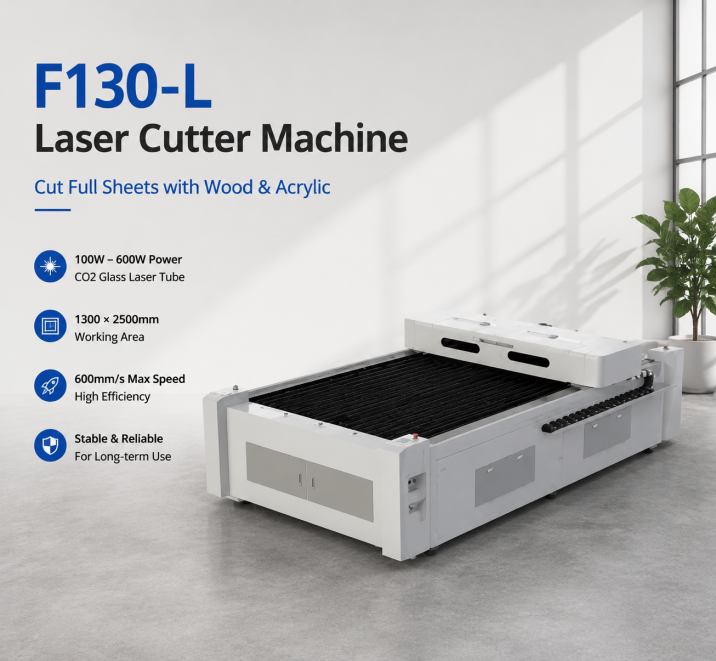
MimoWork offers CO2 laser cutting configurations for different workpiece sizes, power requirements, and production workflows. The appropriate model depends on the actual cutting task rather than power alone.
MimoWork’s CO2 laser systems include configurations spanning different power levels, including selected models rated from 100W to 600W. Higher-power options may support demanding cutting applications, but achievable thickness and speed must be validated for the specific material and machine setup.
For example, the F130-L supports a 1300 × 2500 mm working area and 100–600W configurations. Manufacturers should confirm the available configuration, cooling requirements, and tested cutting results before specifying a system.
The working area should reflect the panel sizes and nesting patterns used in daily production.
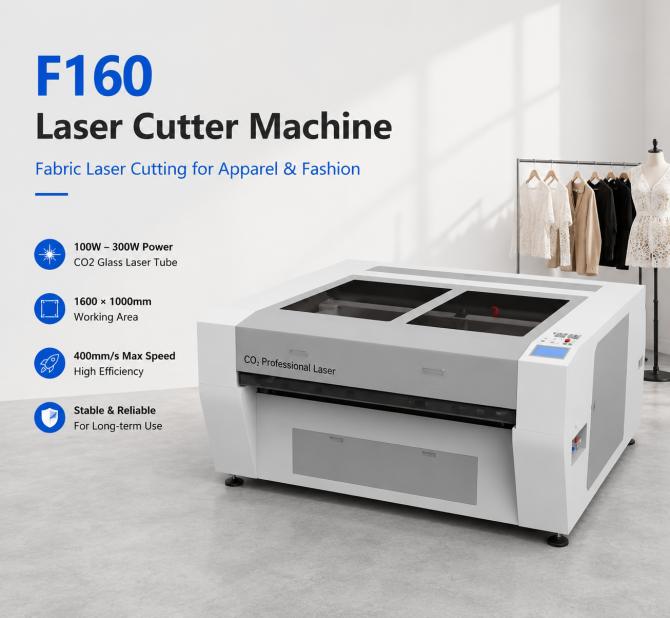
MimoWork’s F160 provides a 1600 × 1000 mm working area with specified CO2 configurations from 100W to 300W. For larger sheet workflows, the F130-L offers a 1300 × 2500 mm area.
Manufacturers should also evaluate loading access, material support, positioning, and whether a conveyor or vision system is beneficial for their workflow. A larger worktable is useful only when the production layout can take advantage of it.
Enclosed systems can help contain laser radiation and smoke when designed and operated with suitable interlocks and extraction. Pass-through or conveyor configurations may accommodate longer or continuous materials, depending on the machine design.
The choice should account for the material dimensions, operator access, loading frequency, and required safety controls. Pass-through access does not remove the need for appropriate laser shielding, interlocks, fire prevention, and fume management.
MimoWork can help manufacturers evaluate machine configurations against their material samples, cutting files, workpiece dimensions, and production targets. A material test is a practical next step before committing to a particular power level or worktable.
There is no universal maximum thickness. Cutting capability varies with laser power, wood species, density, moisture, adhesive composition, cutting speed, and the required edge quality. Confirm the maximum acceptable thickness through representative material testing rather than relying on wattage alone.
It can reduce scorching, but completely burn-free edges cannot be guaranteed for every plywood grade. Appropriate power and speed settings, accurate focus, effective air assist, and suitable extraction help control burning. Adhesives, veneer thickness, and internal voids may still affect the result.
A suitable installation generally requires a properly enclosed laser system with appropriate shielding and interlocks, effective smoke extraction, fire-prevention measures, and maintenance procedures. Filtration or treatment requirements depend on the material and local regulations. Operators should verify material suitability, follow the machine manufacturer’s safety instructions, and never leave active cutting unattended.
Selecting a laser machine to cut wood starts with the material and the finished part, not simply the highest available wattage.
For industrial buyers, the most reliable approach is to test representative wood samples before finalizing the configuration. Share your material type, thickness, sheet dimensions, and cutting file with MimoWork to evaluate a suitable machine setup and identify the practical limits of the proposed solution.
Related guide: https://www.mimowork-laser.com/blog/wood-laser-engraver-and-cutter-buying-guide
News | Oct-27-2026
News | Oct-16-2026