Blog
In a field that evolves daily, staying ahead means staying informed.
Explore in-depth articles designed to help you solve complex challenges,
maximize your machine’s ROI.
Stay ahead in a competitive market.

In a field that evolves daily, staying ahead means staying informed.
Explore in-depth articles designed to help you solve complex challenges,
maximize your machine’s ROI.
Stay ahead in a competitive market.
News | Sep-11-2026
A laser marking machine creates permanent marks by directing a focused laser beam onto a material surface. Unlike traditional ink printing, labeling, or mechanical engraving, laser marking is a digital, non-contact process that can produce precise text, serial numbers, barcodes, QR codes, logos, graphics, and identification marks with high repeatability.
Today, laser marking is used across metal manufacturing, electronics, automotive components, medical devices, consumer products, packaging, jewelry, and industrial traceability. However, there is no single laser marking machine that is ideal for every material or marking effect. Fiber, MOPA, UV, green, and CO₂ lasers interact with materials differently, so the right choice depends on what you are marking, the result you need, and how the machine will fit into your production process.
This guide explains the major types of laser marking machines, their power options, material compatibility, machine formats, applications, costs, and selection factors so you can identify the right laser marking technology for your application.
A laser marking machine uses a focused laser beam to modify a material surface without physical contact. Depending on the laser wavelength, power, pulse characteristics, and processing parameters, the beam can discolor, anneal, remove, or otherwise alter a very small area of the material.
The marking head typically uses a galvanometer scanning system, which moves the laser beam rapidly across the workpiece using precisely controlled mirrors. This allows the machine to mark text, graphics, codes, and other patterns at high speed without moving the entire workpiece or cutting head.
For industrial applications, this combination of digital control and non-contact processing makes laser marking particularly useful for traceability. Serial numbers, production codes, barcodes, logos, and other identification information can be reproduced consistently across large production batches.
Mimowork’s current laser marking systems use different laser sources for different material groups, including Fiber, MOPA, UV, Green, and CO₂ technologies.
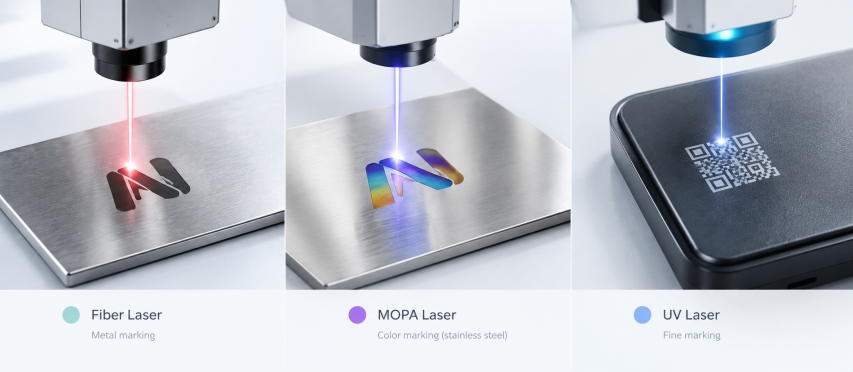
The basic process begins with a digital design or marking file. The software converts the design into instructions for the laser system, including parameters such as speed, power, frequency, and scanning behavior.
The laser source generates the beam, while the galvanometer scanner directs it across the selected marking field. When the beam interacts with the material, controlled energy changes the surface. The exact effect depends on the material and laser parameters.
For example, a fiber laser can create permanent marks on metals by changing or removing a very thin surface layer. MOPA systems provide additional control over pulse characteristics, which can be used for specialized effects such as color marking on stainless steel. UV lasers use a much shorter wavelength and are useful where minimizing thermal impact is important.
A laser marking machine can create much more than simple text. In manufacturing environments, it is commonly used to mark serial numbers, QR codes, barcodes, product codes, logos, and identification information directly onto components.
Depending on the laser source and material, the system can also produce surface discoloration, annealing, engraving, color marking, and other controlled surface effects.
This is why selecting a laser marking machine should begin with the material and desired marking effect, rather than laser power alone.
Laser marking and laser engraving are closely related but are not exactly the same process.
Laser marking generally changes the appearance or properties of the material surface while minimizing material removal. It is widely used for identification, traceability, branding, and decorative marks.
Laser engraving removes material from the surface to create a visible depression. Deeper engraving generally requires more energy, multiple passes, or a higher-power configuration.
The distinction becomes important when selecting a machine. A system that is excellent for high-speed surface marking may not necessarily be the most efficient choice for deep engraving.
The laser source is one of the most important factors determining what a laser marking machine can process. Different wavelengths and pulse characteristics interact with different materials, which is why industrial laser marking systems are divided into several technology categories.
| Laser Type | Typical Power Options | Primary Materials | Typical Applications |
| Fiber Laser | 20W, 30W, 50W | Metals, engineered plastics | Industrial marking, traceability, engraving |
| MOPA Fiber Laser | 60W | Metals, selected plastics | Color marking, precision marking, deep engraving |
| UV Laser | 3W, 5W, 10W | Plastics, glass, electronics | Sensitive-material marking |
| Green Laser | 5W, 10W, 15W, 20W | Reflective materials, glass | Electronics, semiconductors, precision marking |
| CO₂ Laser | 180W, 250W, 500W | Non-metals | Plastics, acrylic, wood, leather, packaging |
Mimowork currently offers these laser marking technologies with different configurations and application targets.
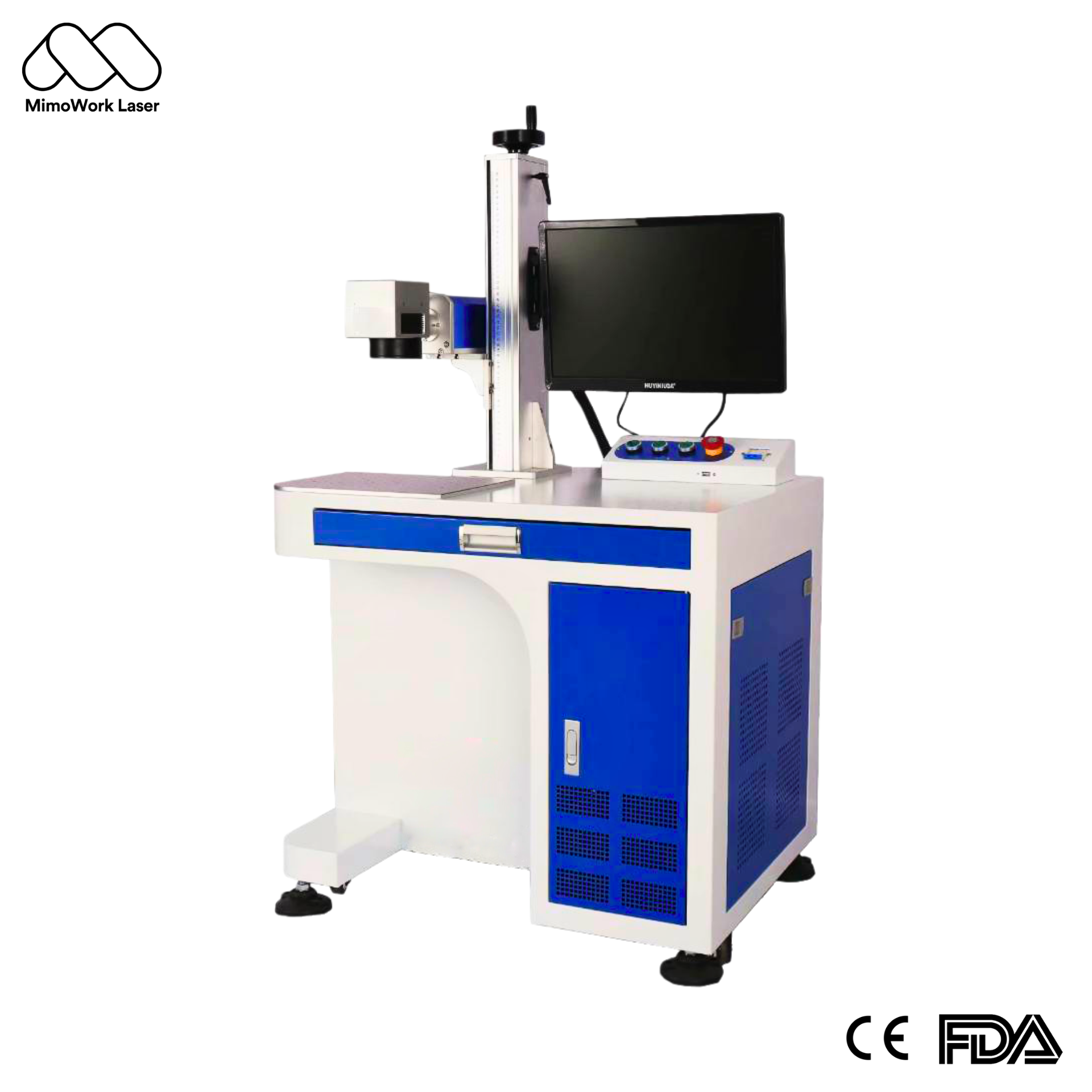
A fiber laser marking machine is one of the most widely used solutions for permanent marking on metal. Fiber lasers are particularly well suited to materials such as stainless steel, aluminum, titanium, and other industrial metals.
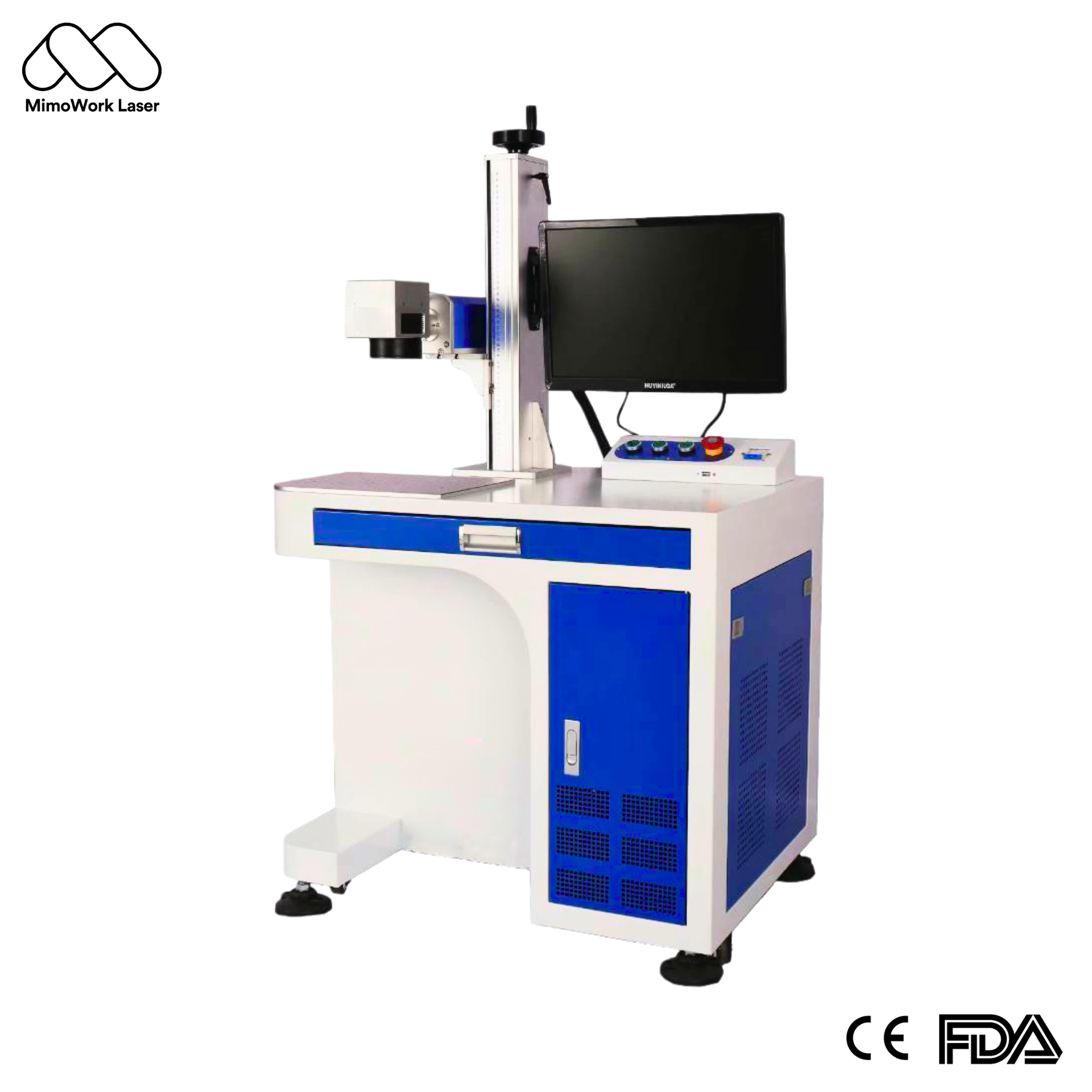
Mimowork’s current fiber laser marking machine uses a fiber laser source and 3D galvanometer beam delivery, with 20W, 30W, and 50W power options. The system supports marking speeds of up to 8,000 mm/s, with working areas ranging from 70 × 70 mm to 200 × 200 mm depending on configuration.
The technology is commonly selected when production requires durable serial numbers, barcodes, logos, data matrix codes, or other permanent identification marks.
Related guide: Fiber Laser Marking Machine: How It Works, Applications & Selection Guide
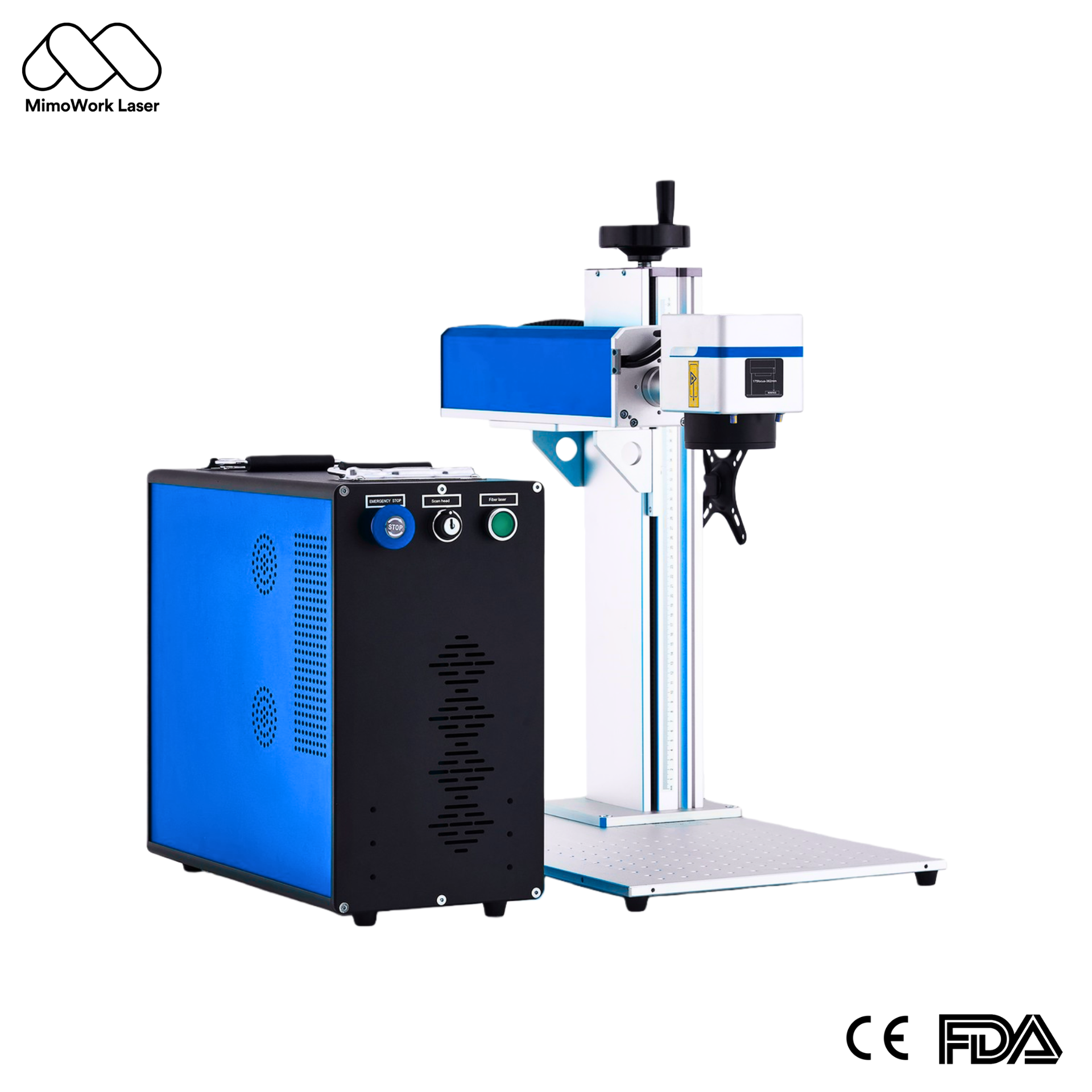
A MOPA fiber laser is based on fiber laser technology but provides more control over pulse width and frequency. This additional control expands the range of marking effects that can be achieved.
For stainless steel, MOPA technology can produce controlled color effects by manipulating the surface oxide layer. It can also be useful for high-contrast black marking, delicate marking, and applications where heat input needs to be carefully controlled.
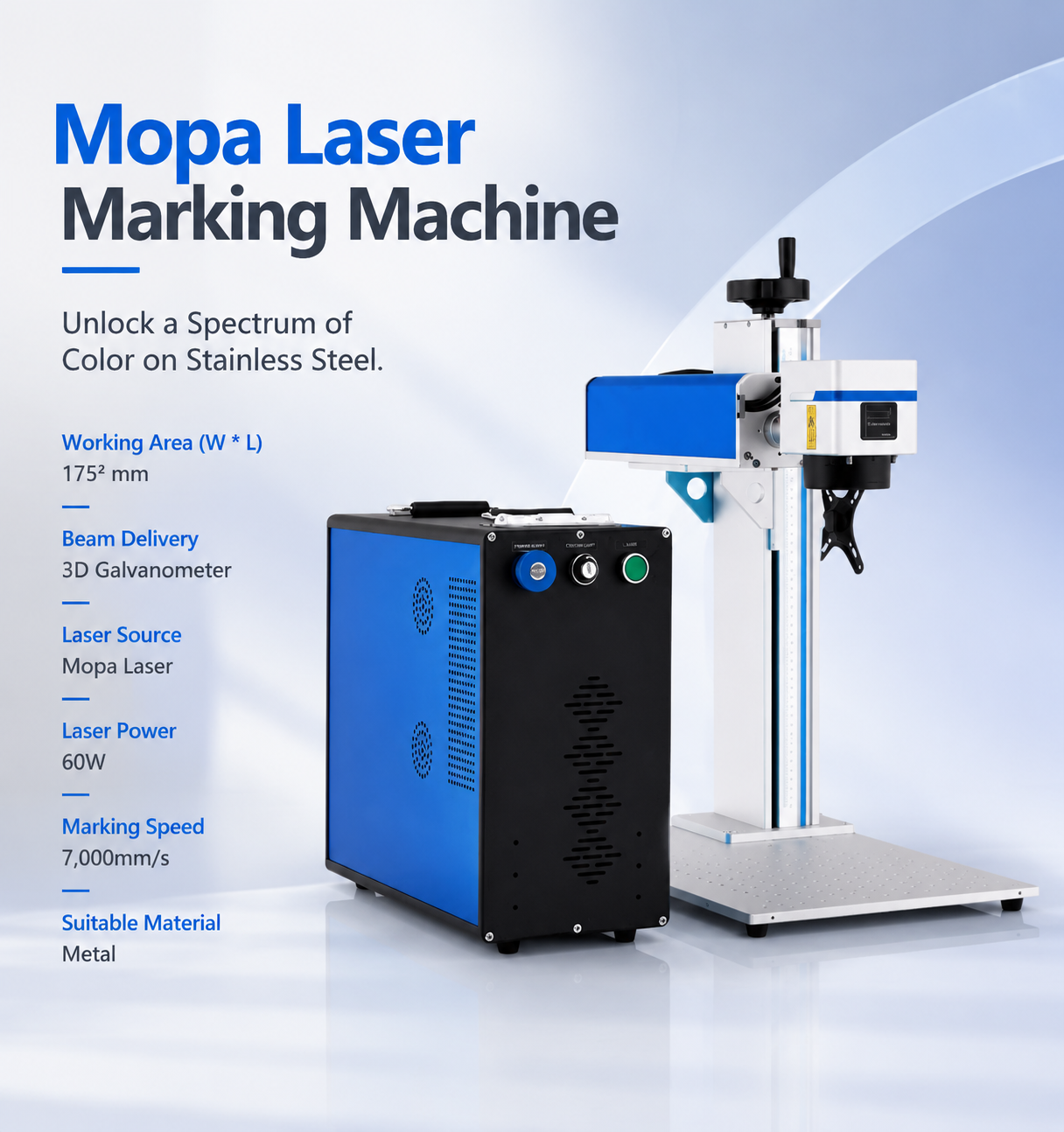
Mimowork’s current MOPA laser marking machine uses a 60W MOPA source, a 175 × 175 mm working area, and a 3D galvanometer system with marking speeds up to 7,000 mm/s.
Related guide: How to Color Engrave Stainless Steel with a MOPA Fiber Laser (Step-by-Step)
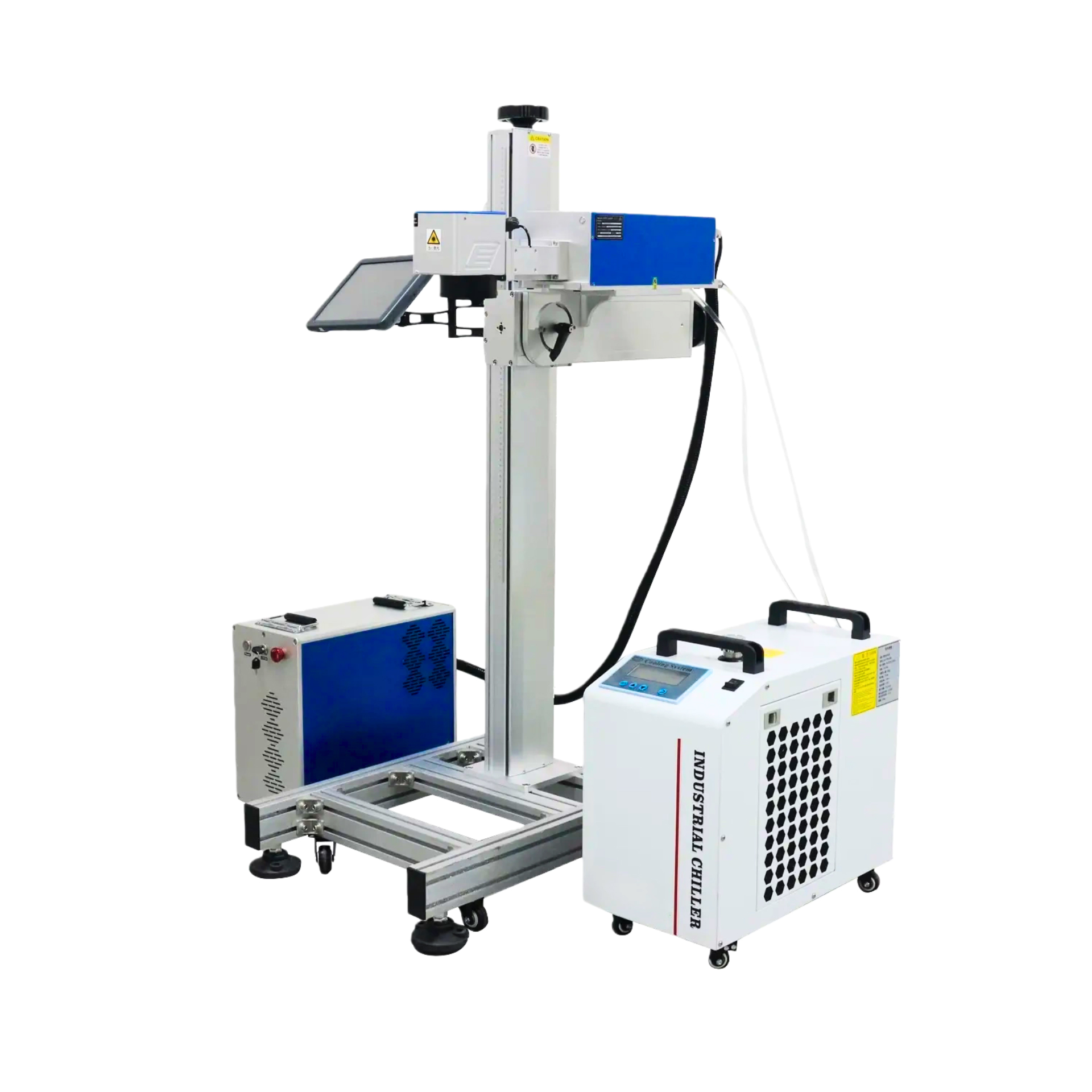
A UV laser marking machine uses a much shorter wavelength than conventional infrared fiber lasers. The shorter wavelength allows the laser energy to interact with materials differently and can reduce unwanted heat effects in applications where surface integrity is important.
UV laser marking is commonly considered for plastics, glass, electronics, medical components, and other heat-sensitive materials. It can create fine, high-contrast marks without relying on conventional inks or labels.
The choice of UV power should still be based on the material, required marking effect, marking area, and production speed rather than power alone.
Related guide: UV Laser Marking Machine: Applications, Materials & Selection Guide
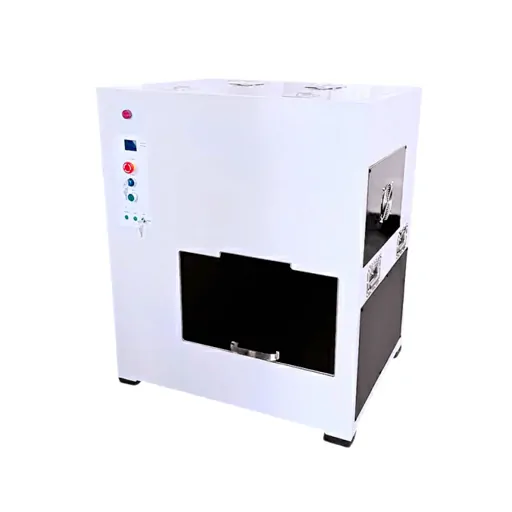
A green laser marking machine operates in the green wavelength range and is particularly useful for applications involving highly reflective materials and sensitive components.
This technology can be considered for applications such as semiconductors, silicon wafers, electronic components, and certain reflective materials where conventional infrared laser processing may not provide the desired result.
Green laser marking is therefore less about replacing a fiber laser and more about solving specific material and precision challenges.
Related guide: Green Laser Marking Guide: Precision Marking on Plastics, Glass, and Copper
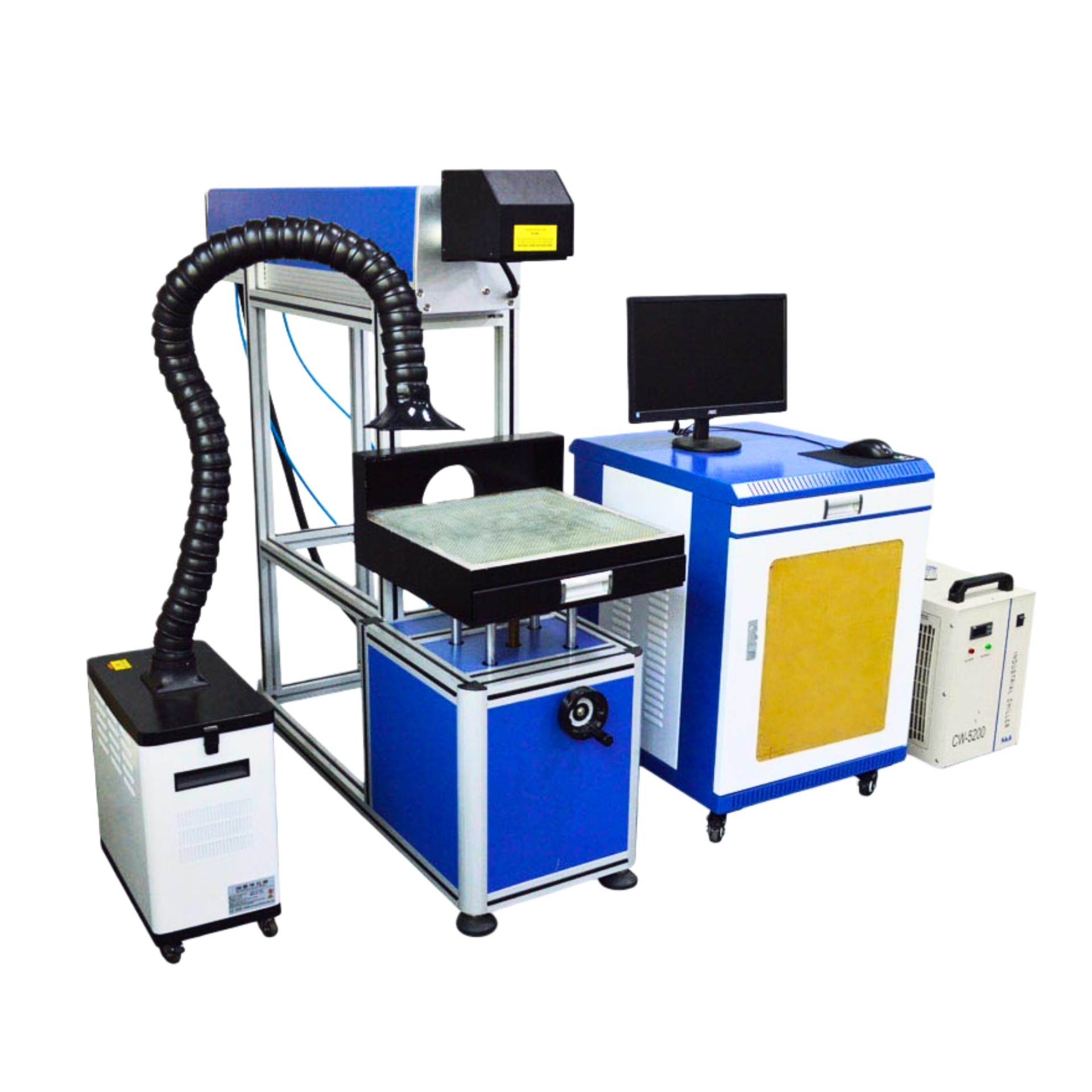
A CO₂ laser marking machine is primarily designed for non-metallic materials. Its longer wavelength is well suited to plastics, acrylic, wood, leather, paper, ceramics, glass, textiles, and packaging materials.
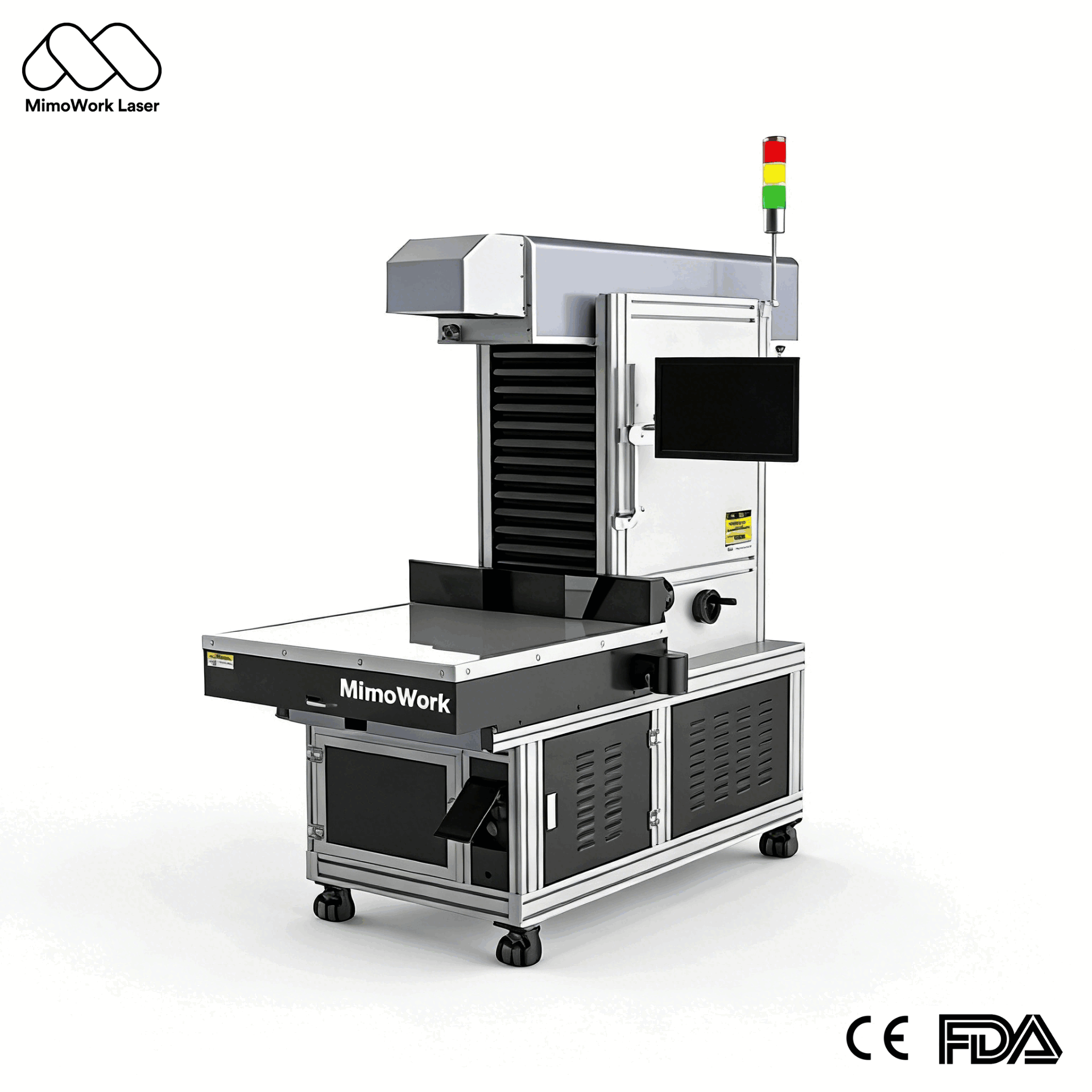
Mimowork’s current CO₂ laser marking system uses an RF metal laser tube, a 3D galvanometer, and power options of 180W, 250W, and 500W. The system has a 400 × 400 mm working area and marking speeds of up to 10,000 mm/s.
For businesses working primarily with non-metals, CO₂ technology can therefore be a more appropriate starting point than a fiber laser.
Related guide: 500W CO₂ Laser Marking Machine: Is High Power Right for Your Application?
Laser power is important, but it should not be treated as a simple ranking where higher wattage always means a better machine.
Power influences how much energy can be delivered to the material over a given period. Higher power can support faster processing or deeper engraving, but marking quality also depends on the laser source, pulse characteristics, scanning speed, focal spot, material properties, and the required marking effect.
For example, Mimowork’s fiber laser marking range currently includes 20W, 30W, and 50W systems, while its MOPA solution is offered at 60W.
| Power | Typical Position | Suitable Applications |
| 20W | General-purpose fiber marking | Serial numbers, logos, basic metal marking |
| 30W | Balanced industrial option | Faster marking, deeper engraving, higher throughput |
| 50W | Higher-throughput fiber marking | Industrial engraving and demanding production |
| 60W MOPA | Advanced pulse-controlled marking | Color marking, precision work, deep engraving |
A 20W fiber laser marking machine can be an appropriate choice when the primary requirement is reliable surface marking rather than aggressive material removal.
It is commonly suitable for serial numbers, logos, barcodes, QR codes, and other identification marks on metal components. For applications where extremely deep engraving or maximum production speed is not required, 20W can provide a practical balance between capability and system complexity.
A 30W fiber laser marking machine provides additional processing capacity compared with a 20W system. It can be useful when the same marking task needs to be completed faster or when deeper engraving is required.
For many general industrial applications, 30W represents a balanced configuration because it provides additional throughput without moving into the higher-power range.
A 50W fiber laser marking machine is more appropriate when production efficiency and engraving depth become more important.
Higher available power can reduce processing time for demanding marking jobs and improve efficiency when a production line handles a large number of components.
A 60W MOPA fiber laser combines higher power with adjustable pulse characteristics. This makes it particularly interesting for applications where the required marking effect is more complex than standard identification marking.
Mimowork’s current 60W MOPA system supports up to 7,000 mm/s marking speed and a 175 × 175 mm working area.
Not necessarily.
The best laser power is the one that matches the material, marking depth, cycle time, and required surface effect. A higher-power laser can improve throughput in some applications, but it does not automatically produce better contrast or finer detail.
For this reason, application testing is especially valuable when choosing between 20W, 30W, 50W, and MOPA configurations.
The physical format of a laser marking machine becomes important when the workpiece cannot easily be placed inside a conventional marking station.
A standard desktop or enclosed system is well suited to smaller components that can be positioned consistently on a worktable. By contrast, a portable or handheld configuration can be useful when the workpiece is oversized, heavy, fixed in place, or difficult to transport.
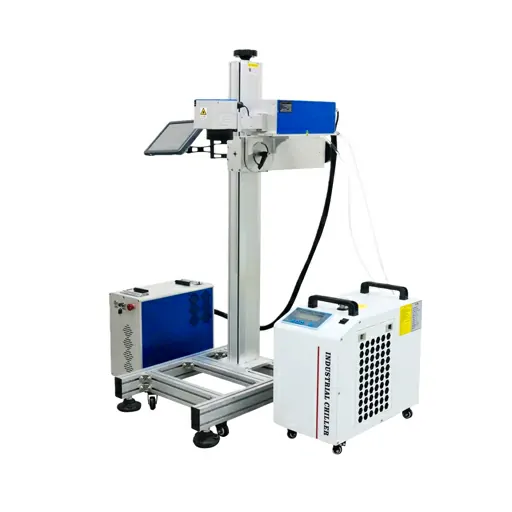
Mimowork’s fiber laser system can be configured with a handheld marking system, while its standard system can also be upgraded with safety enclosure, field-of-view lens, and in-line production integration options.
A portable laser marking machine gives operators more flexibility when marking large machinery, metal structures, industrial equipment, or components that are difficult to move.
Instead of bringing the workpiece to a fixed marking table, the marking head can be positioned around the component.
The main advantage is therefore not simply portability. It is the ability to adapt the marking process to the physical constraints of the production environment.
Related guide: Portable Laser Marking Machine: What to Know Before You Buy
A mini fiber laser marking machine or desktop fiber laser marker is designed for applications where the components are relatively small and the operator benefits from a compact working setup.
Desktop systems are particularly convenient for workshops, laboratories, jewelry applications, small metal components, and businesses that do not require a large marking field.
Machine format also affects how the marking system fits into the working environment.
An open laser marking system provides convenient access to the workpiece and can be useful for large components or applications that require flexible positioning. An enclosed fiber laser, on the other hand, provides a more controlled operating environment and can incorporate interlocks and extraction systems.
For production environments where operator protection, process control, and repeatability are priorities, an enclosed configuration can provide important advantages.
Mimowork offers safety enclosure options for its fiber and CO₂ marking systems, including configurations with integrated extraction and filtration paths.
An enclosed fiber laser is worth considering when the machine will operate in a dedicated production area, when multiple operators use the system, or when safety and process control need to be standardized.
The decision should also take into account the workpiece size, loading method, ventilation requirements, and whether the system will eventually be integrated into an automated production line.
The material should be the starting point for laser selection.
A metal component requiring a permanent serial number has very different processing requirements from a transparent plastic component, silicon wafer, acrylic panel, or wooden product. The laser wavelength determines how efficiently the material absorbs the laser energy, while power and pulse characteristics influence the resulting mark.
| Material / Application | Suitable Laser Technology | Typical Marking Objective |
| Stainless Steel | Fiber / MOPA | Permanent identification, black marking, color marking |
| Aluminum | Fiber / MOPA | Surface marking, engraving, contrast marking |
| Copper & Brass | Fiber / Green | Reflective-metal marking |
| Sensitive Plastics | UV / MOPA | Fine, low-thermal-impact marking |
| Acrylic & Wood | CO₂ | High-contrast surface marking |
| Glass & Ceramics | CO₂ / UV / Green | Fine surface marking |
| Silicon & Semiconductor Materials | Green / UV | Precision component marking |
Actual compatibility depends on the exact material formulation, surface treatment, and desired marking effect, so sample testing should be performed for critical applications.
Stainless steel is one of the most common applications for fiber and MOPA laser marking.
A standard fiber laser can create durable identification marks at high speed, while a MOPA laser provides additional control over the laser pulse. This makes MOPA particularly valuable when the application requires color marking or more precise thermal control.
Mimowork identifies both fiber and MOPA systems as suitable technologies for stainless steel applications.
Plastic processing requires more careful laser selection because different polymers react very differently to laser energy.
A UV laser can be useful when the application requires fine marking with limited heat impact. This makes it particularly relevant to electronics, medical components, and sensitive plastic products.
Mimowork’s UV laser marking system is positioned for sensitive materials and includes plastics and glass among its application areas.
Reflective metals such as copper, brass, aluminum, gold, and silver can present additional challenges because they reflect a significant portion of incoming laser energy.
Fiber, MOPA, and green laser technologies can all have roles in reflective-material processing, but the appropriate choice depends on the material, surface finish, required contrast, and marking depth.
A standard flat marking field works well for flat components, but cylindrical objects create a different challenge. If a logo or serial number needs to wrap around a bottle, tube, ring, bearing, or other round component, the workpiece must rotate in coordination with the laser beam.
A laser marking machine rotary setup solves this problem by synchronizing the rotation of the workpiece with the marking process.
The rotary system essentially converts the curved surface into a controlled marking path, allowing text, logos, and identification codes to be applied around cylindrical products.
The rotary attachment holds the cylindrical workpiece and rotates it at a controlled rate while the laser scanner creates the marking pattern.
This allows applications such as ring marking, tube identification, cylindrical component traceability, and product personalization without requiring a completely different laser source.
A laser wire marking machine is designed for identifying wires, cables, and similar elongated components.
Instead of applying printed labels or mechanical markings, laser processing can create permanent identification directly on suitable cable jackets or surfaces. This can be valuable where traceability and long-term readability are important.
However, wire marking is highly material-dependent. Cable insulation, diameter, color, surface treatment, and required contrast all influence the appropriate laser source and parameters.
For this reason, the cost of a laser wire marking machine should not be evaluated independently from the marking material and production requirements.
The laser marking machine price depends on much more than the laser source itself.
Power is one factor, but the marking area, laser source, galvanometer scanner, lens, machine format, enclosure, cooling system, rotary attachment, vision system, automation, and software configuration can all affect the final system cost.
For fiber laser systems, for example, Mimowork currently offers 20W, 30W, and 50W configurations, with different working areas and optional system upgrades.
A basic desktop marking system and a fully enclosed production system may therefore have very different prices even if they use the same general laser technology.
The first major factor is the laser source and power. Higher power can support faster production or deeper engraving, but it is only worthwhile when the application actually benefits from it.
The second factor is the optical system. Galvanometer speed, lens selection, marking field, and focus characteristics directly affect productivity and marking quality.
The third factor is machine configuration. An enclosed system, handheld system, rotary attachment, vision system, or in-line production integration can significantly change the overall equipment configuration.
The cheapest system is not necessarily the most economical system.
If a standard fiber laser can produce the required mark, paying for MOPA capabilities that are never used may not provide a meaningful return. Conversely, if color marking is a core requirement, choosing a standard fiber laser simply because it has a lower initial cost may create limitations later.
The better approach is to evaluate the total cost against the required marking effect, throughput, material range, and expected production life.
Choosing a laser marking machine becomes much easier when the decision is made in the correct order.
First determine exactly what you need to mark. Metal, plastic, glass, wood, ceramics, silicon, and coated materials absorb laser energy differently.
This immediately narrows the appropriate laser technologies.
Next, decide what the finished mark should look like.
A simple serial number may only require a high-contrast surface mark. A production component may require deep engraving. A stainless-steel consumer product may require a specific color. An electronic component may require extremely fine marking with minimal thermal impact.
These requirements can point toward very different laser sources.
Once the material and marking effect are established, select the laser source and power.
For general metal marking, fiber is often the starting point. For advanced metal effects such as color marking, MOPA can provide additional control. For sensitive plastics, UV may be more appropriate, while CO₂ is commonly suited to non-metallic materials.
The physical size and shape of your products should determine whether you need a desktop, enclosed, portable, handheld, or rotary configuration.
A compact component may work perfectly well on a desktop galvo system. A large industrial machine may require a handheld setup. A cylindrical product may need a rotary attachment.
Finally, consider production volume and integration.
A machine used for occasional customization has different requirements from one operating continuously on a manufacturing line. Marking speed, repeatability, automation, vision inspection, loading method, and extraction can all become important as production volume increases.
Laser marking has become an important part of modern manufacturing because it combines permanent identification with digital process control.
Industrial manufacturers use laser marking to create serial numbers, production codes, barcodes, QR codes, and data matrix codes. These marks can remain readable throughout the service life of the component, making them useful for traceability and quality control.
Fiber laser marking is particularly well suited to this type of application because it can create permanent marks on metal components at high speed.
Metal marking covers a wide range of industries, from automotive components and tools to machinery parts, electronics, jewelry, and consumer products.
The required marking effect determines the most suitable technology. Standard fiber systems are often used for permanent identification and engraving, while MOPA can be selected when color or specialized pulse control is required.
Electronics and consumer products often require small, clean marks that do not compromise the appearance or function of the component.
Jewelry applications may require fine logos, serial numbers, names, or decorative patterns. Electronics may require precise identification on relatively small components.
For these applications, beam quality, focus control, marking field, and laser wavelength can be just as important as raw power.
When comparing laser marking machines, it is easy to focus too heavily on laser wattage. In practice, the supporting optical and mechanical systems can have an equally important effect on the finished result.
| Feature | Why It Matters |
| Galvo Scanner | Controls fast and precise beam positioning |
| Working Area | Determines the maximum marking field |
| F-Theta Lens | Helps maintain consistent focus across the field |
| Autofocus | Simplifies setup for different workpiece heights |
| Rotary Attachment | Enables marking on cylindrical objects |
| Vision System | Helps align marks with complex components |
| Safety Enclosure | Provides a more controlled operating environment |
| Fume Extraction | Helps manage process fumes and particles |
| Software | Controls designs, parameters, codes, and production jobs |
| Production Integration | Connects marking with automated manufacturing workflows |
A well-designed system should also leave room for future upgrades. For example, Mimowork’s fiber marking platform can be configured with handheld marking, safety enclosure, field-of-view lens, and in-line production integration options.
This type of modular approach can be useful when the initial application is relatively simple but production requirements may become more demanding over time.
Laser marking is a precision manufacturing process, but the machine should always be selected and operated with safety in mind.
The appropriate safety configuration depends on the laser class, machine design, application, and operating environment.
For production environments with multiple operators, an enclosed system can provide a more controlled setup. Interlocked enclosures can also help prevent unintended exposure during operation.
Laser processing can generate fumes and particulates depending on the material.
This is particularly important when processing plastics and other materials that may release hazardous substances. Mimowork specifically warns that processing PVC or PTFE-based materials with its laser marking systems can generate hazardous fumes and recommends appropriate PPE and high-efficiency fume extraction.
Material safety should therefore be considered before testing a new material, not after production has already started.
Operators should follow the machine manufacturer’s safety procedures and use the appropriate protective equipment for the specific application.
The safety configuration should be treated as part of the laser marking system itself rather than as an optional afterthought.
Related guide: High-Performance Fume Extractors for Laser Engravers: Protect Your Health & Machine
A laser marking machine is used to create permanent identification, traceability, decorative, or functional marks on materials. Common examples include serial numbers, barcodes, QR codes, logos, product codes, and engraved graphics.
For general metal marking, a fiber laser is usually the starting point. MOPA fiber lasers are particularly useful when the application requires color marking or more advanced pulse control.
MOPA is a type of fiber laser technology with greater control over pulse characteristics such as pulse width and frequency. This additional control can produce specialized effects, including color marking on stainless steel.
Yes. Fiber and MOPA laser marking machines are both widely suited to stainless steel. The appropriate choice depends on whether the application requires standard permanent marking, deep engraving, or color effects.
Yes, but the best laser source depends on the specific plastic. Fiber, MOPA, UV, and CO₂ lasers can all have applications in plastic marking, depending on the material formulation and desired result.
There is no universal wattage recommendation. A 20W system may be sufficient for standard surface marking, while 30W or 50W can provide additional throughput or engraving capability. More advanced applications may require a 60W MOPA system.
Yes. MOPA fiber laser technology can create color effects on suitable metals, particularly stainless steel, by controlling the interaction between the laser and the material surface.
Yes. A rotary attachment can synchronize workpiece rotation with the laser marking process, allowing cylindrical components such as tubes, rings, and other round products to be marked.
The best laser marking machine is not necessarily the one with the highest power or the largest working area. It is the system that matches the material, marking effect, production volume, workpiece geometry, and operating environment.
Mimowork provides multiple laser marking technologies rather than relying on a single laser source for every application. Its current portfolio covers fiber, MOPA, UV, green, and CO₂ marking systems, allowing the laser source to be matched more closely with the material and required marking effect.
For businesses evaluating a new laser marking machine, the most reliable approach is to define the material, desired marking effect, production volume, and workpiece size first. From there, laser source, power, working area, machine format, and optional automation can be selected according to the actual application.
Related guide: Laser Marking Machine Buying Guide: How to Choose the Right System
If you are still comparing laser technologies, testing the actual material and marking effect before finalizing the machine configuration can help avoid choosing a system based only on specifications. For industrial applications, this application-first approach is often the most effective way to select a laser marking machine that can deliver consistent results in real production.
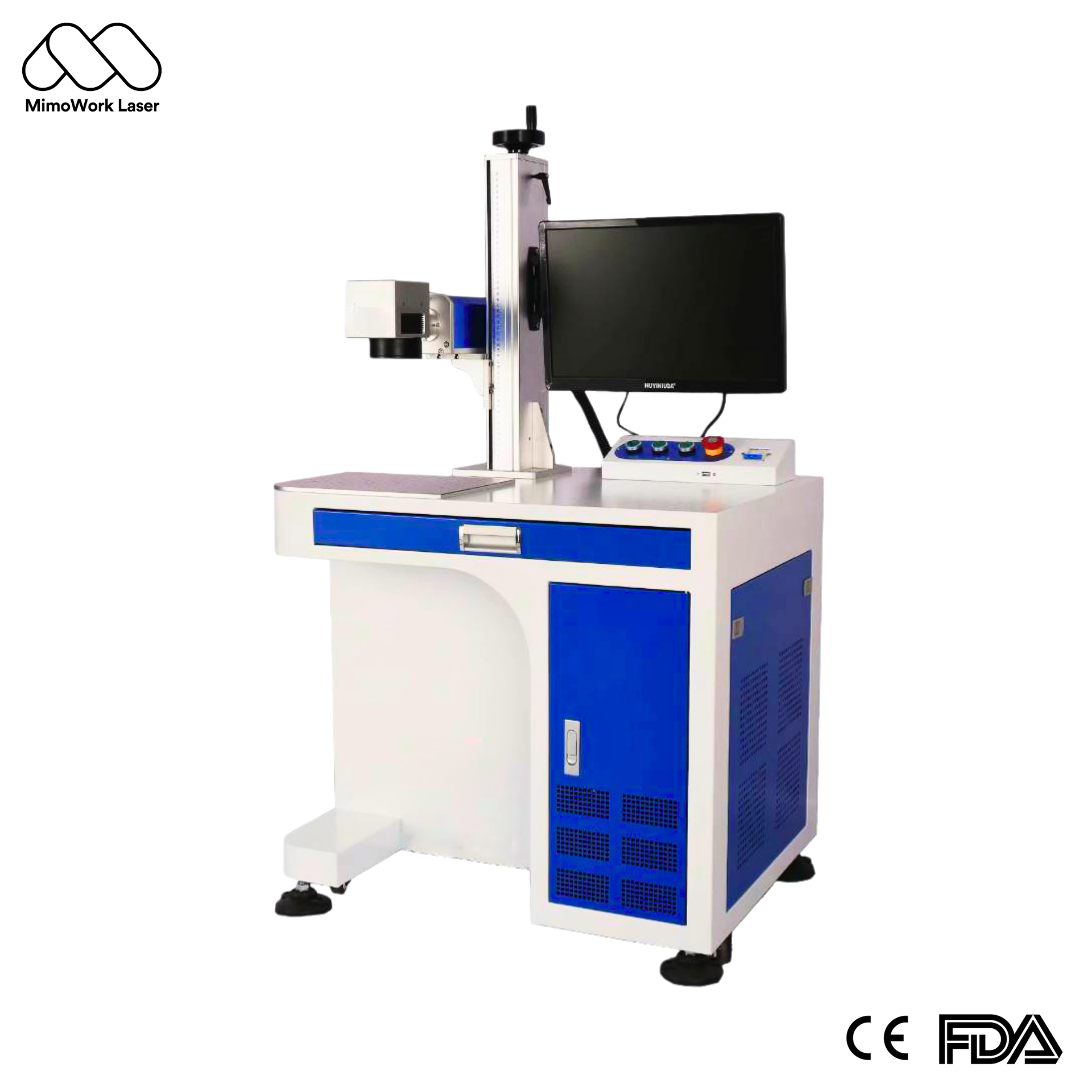
News | Sep-4-2026