Blog
In a field that evolves daily, staying ahead means staying informed.
Explore in-depth articles designed to help you solve complex challenges,
maximize your machine’s ROI.
Stay ahead in a competitive market.


In a field that evolves daily, staying ahead means staying informed.
Explore in-depth articles designed to help you solve complex challenges,
maximize your machine’s ROI.
Stay ahead in a competitive market.
News | Sep-21-2026
Choosing a wood laser engraver and cutter starts with understanding how your woodworking requirements fit into a CO2 Laser Cutter system. Wood, plywood, MDF, veneer, bamboo, and many other wood-based materials can be processed with a CO₂ laser, but cutting thickness, engraving detail, production speed, and working area all depend on the machine configuration. For businesses making signs, decorative products, furniture components, prototypes, or personalized gifts, choosing the right laser is more important than simply selecting the highest available power.
A wood laser engraver and cutter is a good choice when you need both precise engraving and clean, programmable cutting on wood-based materials.
For thin wood and detailed engraving, lower-power CO₂ systems can provide sufficient control. For thicker plywood, hardwood components, or higher-volume production, a higher-power machine with a larger working area may be more appropriate. The ideal configuration depends on the actual material, thickness, product size, and production volume rather than laser wattage alone.
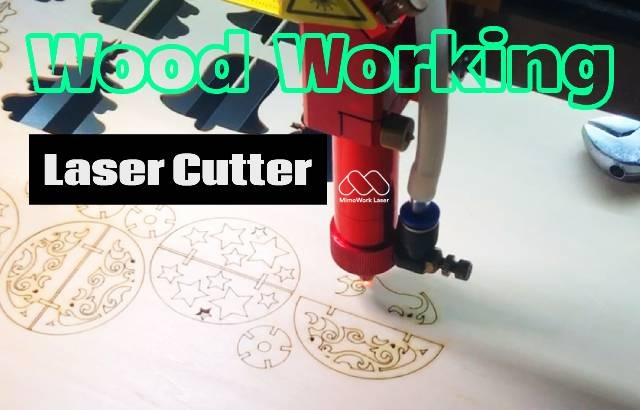
A wood laser engraver and cutter combines two different processing functions in one system.
During laser engraving, the focused CO₂ laser beam removes or darkens a controlled portion of the wood surface to create text, logos, patterns, photographs, textures, or decorative details.
During laser cutting, the beam follows a programmed cutting path and concentrates enough energy to penetrate the material. Because the process is non-contact, there is no physical cutting tool pressing against the workpiece.
This distinction is important for woodworking businesses. A machine that performs well for engraving small decorative patterns does not necessarily have the power, work area, or production configuration required for cutting thicker plywood or large wooden panels.
Wood is one of the common non-metal materials processed by CO₂ laser systems. The infrared wavelength generated by a CO₂ laser is well suited to many organic and non-metallic materials, allowing the laser to thermally remove material without mechanical contact.
This gives laser processing several practical advantages for woodworking.
Instead of using a rotating cutting tool, the laser can follow highly detailed digital paths. Intricate patterns, small holes, curved contours, lettering, and repeated designs can therefore be produced without changing physical cutting tools.
For customized products, this is particularly useful. A digital design can be modified and sent to the machine without manufacturing a new cutting die or template.
Not all wood behaves in exactly the same way under a laser. Density, moisture content, resin, glue, surface coating, and material construction can influence the final result.
| Wood Material | Typical Laser Application | Main Consideration |
| Plywood | Signs, boxes, models, furniture components | Adhesive layers can affect cutting |
| MDF | Decorative panels, prototypes, displays | Dense structure requires suitable power |
| Hardwood | Furniture parts, decorative products | Density varies significantly |
| Veneer | Surface decoration, patterns | Requires controlled energy input |
| Bamboo | Gifts, panels, decorative items | Grain structure can affect engraving |
| Wood Board | Signs, panels, structural components | Thickness determines cutting requirements |
Plywood is particularly popular because it provides relatively consistent sheet dimensions, but different plywood constructions can behave differently because of their internal adhesive layers. Before production, testing the exact material is therefore more reliable than relying only on a general thickness chart.
Laser power directly influences cutting capability, but higher wattage should not automatically be interpreted as better performance.
For example, a small workshop producing engraved wooden gifts may prioritize engraving speed, fine detail, and compact equipment. A manufacturer cutting thicker plywood components throughout the day has a completely different requirement.
As a general reference, MimoWork’s current wood laser guidance places lower-power systems around the range suitable for thinner plywood and engraving, while higher-power configurations become increasingly relevant for thicker materials and industrial production. Actual results depend on material density, thickness, cutting speed, focal conditions, and other parameters.
The better question is therefore not:
“What is the strongest laser?”
It is:
“What laser power can process my material at the required quality and production speed?”
Working area determines how large a sheet or product can be processed without repositioning.
For personalized gifts or small decorative products, a compact working area may be sufficient. A business producing signage, wall panels, furniture components, or larger decorative structures may benefit from a larger flatbed system.
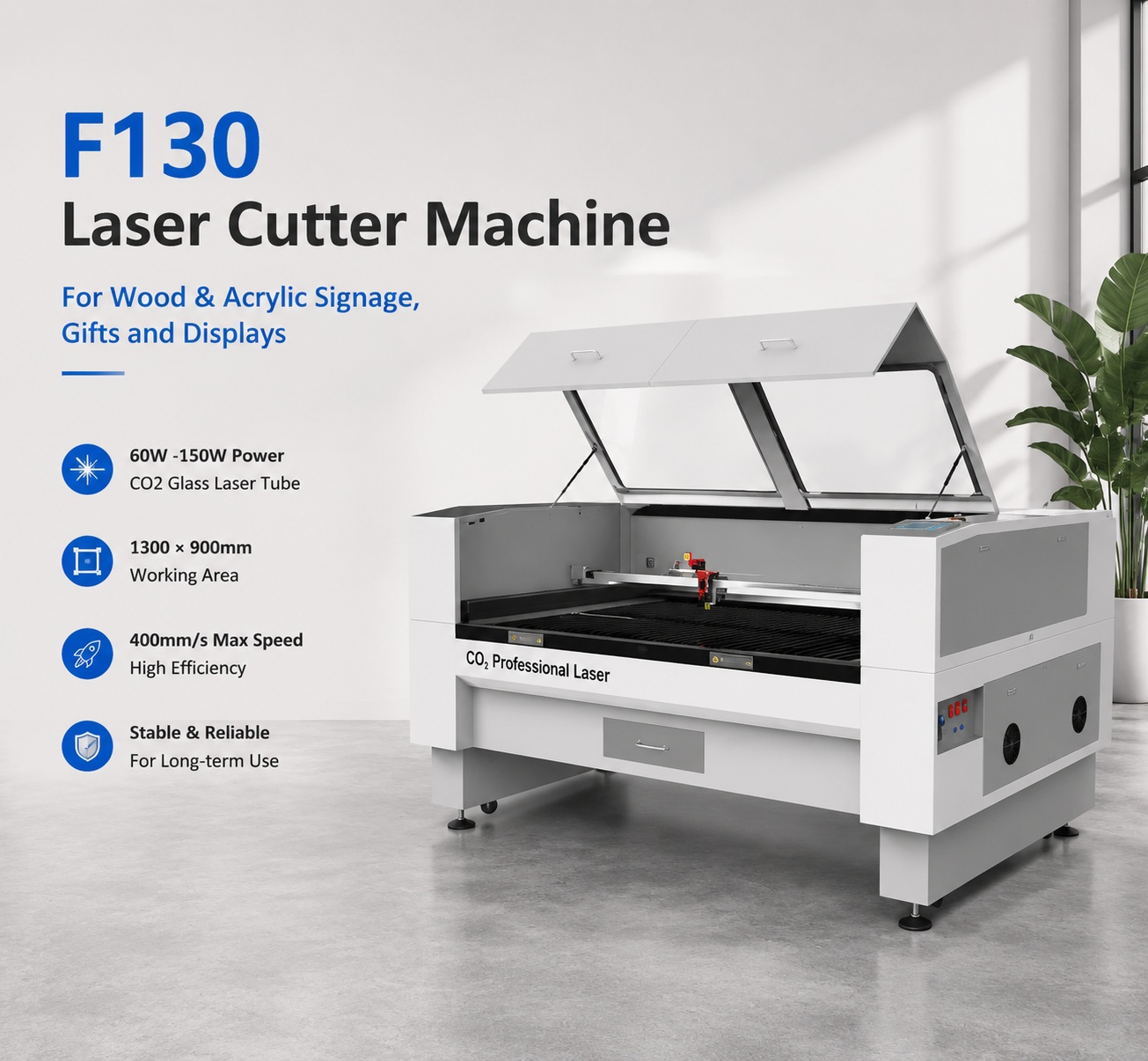
For example, MimoWork currently offers configurations ranging from compact systems such as the F60 through larger machines such as the F130, with different working areas and power configurations for different applications.
A larger working area can also improve production efficiency because multiple parts can sometimes be arranged on one sheet. This makes material nesting and workflow planning an important part of machine selection.
When buyers compare wood laser engravers, they often focus heavily on wattage. However, engraving quality also depends on beam control, optical alignment, focusing, motion accuracy, software settings, and material characteristics.
For fine lettering and detailed graphics, excessive power can actually make parameter control more difficult because the laser removes more material than necessary.
The goal is controlled energy delivery.
A well-configured machine should allow operators to adjust parameters such as power and speed so that the laser produces the required surface effect without excessive charring or unnecessary material removal.
Burning is one of the most common concerns when laser cutting wood.
Some degree of thermal discoloration can occur because the laser is intentionally generating heat to remove material. However, excessive burning can often be reduced through proper parameter selection and machine configuration.
Air assist is particularly important because it helps remove smoke and debris from the cutting zone while supporting more stable processing. Proper focusing, clean optics, appropriate cutting speed, and suitable material preparation also influence the final edge quality.
The wood itself matters as well. Moisture, resin content, density, and adhesive composition can produce different results even when two materials have the same nominal thickness.
Laser processing does not necessarily replace every woodworking machine. Instead, it offers a different production method.
| Factor | Wood Laser Engraver and Cutter | Traditional Cutting Tools |
| Cutting method | Thermal, non-contact | Mechanical contact |
| Fine patterns | Excellent for intricate digital designs | Depends on tooling |
| Tool changes | Minimal for digital designs | Physical tools may be required |
| Small holes/details | Highly suitable | Can require specialized tooling |
| Engraving | Integrated into same workflow | Often requires another process |
| Edge characteristics | Heat-affected edge possible | Mechanical edge |
| Repeated designs | Digital and highly repeatable | Depends on setup |
| Dust generation | Smoke/fume management required | Sawdust and chips |
The choice depends on the product. A laser is particularly attractive when a production workflow combines cutting and engraving or frequently changes designs.
The right machine should be selected from the complete production workflow rather than one specification.
First, identify the materials you process most frequently. Then determine the maximum thickness that needs to be cut and the largest workpiece you expect to process.
After that, consider production volume.
A small business producing customized signs may value flexibility and compactness. A manufacturer producing hundreds of repeated components may prioritize cutting speed, larger working areas, automatic feeding, and continuous operation.
Software compatibility should also be considered. A practical laser workflow typically involves vector design, raster engraving, parameter adjustment, machine control, and repeat production. Compatibility with commonly used design and laser-control software can reduce unnecessary workflow changes.
Related Guide: Before You Buy a Wood Laser Engraver and Cutter: What Don’t the Brands Tell You?
Yes. CO₂ laser systems are widely used for cutting and engraving many types of wood and wood-based materials. The achievable thickness and cutting quality depend on laser power, material properties, speed, focus, and machine configuration.
There is no single power that is best for every wood application. Lower-power systems can be suitable for thin materials and engraving, while higher-power systems are more appropriate when cutting thicker wood or increasing production speed.
Yes. A properly configured CO₂ laser can perform both engraving and cutting. The required settings change according to plywood thickness, density, adhesive composition, and desired edge quality.
The laser removes material through heat, so thermal discoloration can occur. Excessive burning may result from unsuitable power and speed settings, poor focus, insufficient air assistance, or characteristics of the wood itself.
Neither technology is universally better. A laser is particularly useful for precise cutting, engraving, intricate patterns, and digital customization. CNC routing can be advantageous for thicker materials, mechanical cutting, and applications where physical tooling is preferred.
A wood laser engraver and cutter can combine detailed engraving and programmable cutting in a single digital workflow, making it suitable for customized products, signage, decorative panels, prototypes, and many manufacturing applications.
The most important selection criteria are not simply laser wattage or machine price. Material type, thickness, working area, engraving requirements, production volume, air assistance, smoke extraction, and future expansion should all be evaluated together.
For businesses processing wood regularly, the right CO₂ laser configuration can provide a flexible production platform that moves easily from one digital design to the next without traditional tooling changes.
News | Sep-4-2026
News | Aug-7-2026