Blog
In a field that evolves daily, staying ahead means staying informed.
Explore in-depth articles designed to help you solve complex challenges,
maximize your machine’s ROI.
Stay ahead in a competitive market.


In a field that evolves daily, staying ahead means staying informed.
Explore in-depth articles designed to help you solve complex challenges,
maximize your machine’s ROI.
Stay ahead in a competitive market.
News | Oct-4-2026
Quick Answer: Stainless laser welding can provide concentrated heat input, narrow weld zones, low distortion, and high automation potential, while TIG and MIG remain valuable for applications requiring greater joint-gap tolerance, established manual workflows, or specific material and production conditions. The better process depends on joint design, thickness, fit-up, appearance requirements, production volume, operator skill, and automation goals rather than on speed alone.
Stainless steel is widely used because it combines corrosion resistance, strength, durability, and appearance. Those same properties can make welding challenging.
Heat control matters. Excessive heat can increase discoloration and distortion, while insufficient energy can produce incomplete fusion. Joint preparation also influences the process because different welding technologies have different tolerance for gaps and variation.
This creates a practical question for manufacturers: should stainless steel components continue to be welded with TIG or MIG, or is laser welding a better production route?
There is no universal answer. The right process depends on what the factory is trying to optimize.
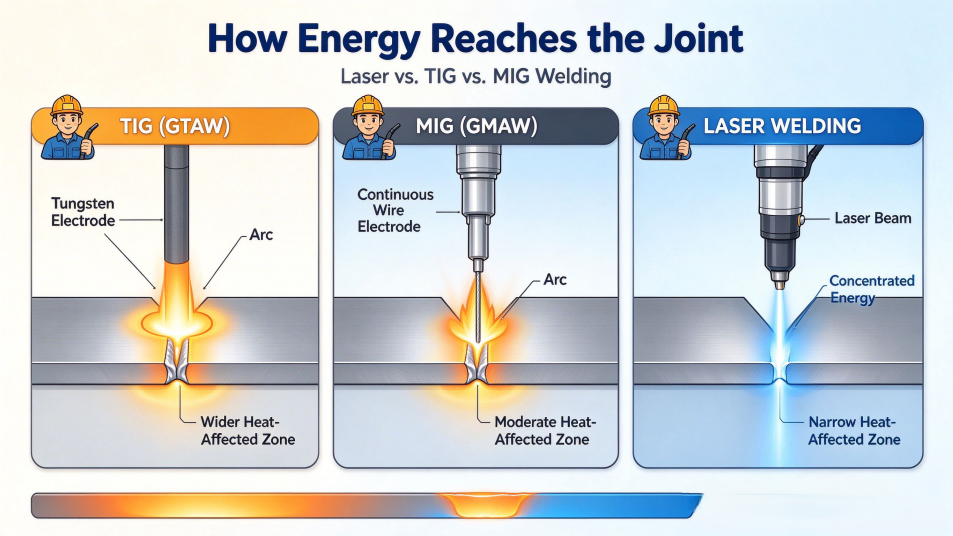
The fundamental difference is how energy reaches the joint.
TIG uses an arc between a tungsten electrode and the workpiece. MIG uses an arc and continuously supplied wire electrode. Laser welding uses a concentrated laser beam to deliver energy to a small region.
Because the laser can concentrate energy into a relatively small area, the thermal footprint can be limited compared with some conventional arc processes.
That can reduce the amount of surrounding material exposed to high heat.
However, laser welding is also less forgiving of poor joint preparation. A highly concentrated beam does not automatically compensate for a large or inconsistent gap.
| Factor | Laser welding | TIG | MIG |
| Heat concentration | Very high | High | Moderate |
| Heat-affected area | Generally narrow | Wider | Wider |
| Distortion potential | Low when properly controlled | Higher | Higher |
| Welding speed potential | High | Lower | Higher |
| Appearance | Clean and precise | Excellent | Good |
| Joint-gap tolerance | Often more demanding | More forgiving | More forgiving |
| Automation potential | High | Medium to high | High |
| Filler material | Optional depending on joint | Commonly used | Normally supplied continuously |
| Operator skill | High process/setup skill | High | Moderate to high |
| Best production fit | Precision/high-throughput applications | Quality-focused manual welding | General fabrication and production |
The table describes general process characteristics rather than guaranteed machine performance.
Stainless steel can be visually sensitive to welding heat.
Excessive heat may produce distortion or discoloration and can increase the amount of post-welding finishing required.
Laser welding’s concentrated energy can help control the size of the heated region.
This does not mean every laser weld will automatically be distortion-free. Welding parameters, joint geometry, material thickness, clamping, travel speed, shielding, and beam characteristics all influence the result.
TWI research into laser and hybrid welding of stainless steel illustrates that process selection involves balancing penetration, weld quality, productivity, and joint conditions rather than simply choosing a higher-power laser.
TIG welding remains highly useful when appearance, control, and manual flexibility are priorities.
A skilled TIG operator can manage the weld pool carefully and adapt to variations in the workpiece.
This is particularly useful for prototypes, repair work, complex joints, and applications where production volumes are too low to justify extensive automation.
TIG can also be more tolerant of certain joint conditions because the operator can introduce filler material and adjust the process dynamically.
The downside is that manual welding speed can become a bottleneck as production volume increases.
MIG welding is widely used when production speed and material deposition are important.
Continuous wire feeding makes it practical for fabrication and repetitive production.
Compared with TIG, MIG can reduce welding time for many production applications. However, the process can introduce more heat and may require additional finishing depending on the required appearance.
For large structural assemblies where aesthetics is secondary, MIG may remain a very practical solution.
The greatest opportunity for laser welding often appears when a business has many repeated joints.
Consider a manufacturer producing hundreds of stainless enclosures.
If every part requires manual welding followed by grinding and finishing, labor is spread across several operations.
A properly engineered laser process can potentially reduce the thermal footprint and minimize post-weld finishing requirements.
That changes the economics.
The question is no longer simply “Which welding process is faster?”
It becomes:
How many total production steps are required to deliver a finished part?
One of the biggest misconceptions about laser welding is that its precision makes joint preparation irrelevant.
The opposite is often true.
Because the laser concentrates energy into a small region, joint alignment and gap control can be critical.
A production line considering laser welding should therefore evaluate upstream fabrication.
Are components consistently cut?
Are bends repeatable?
Are edges clean?
Are gaps controlled?
If not, improving the laser welding system without improving component preparation may not solve the real production problem.
Laser welding is often most effective when combined with precise upstream manufacturing.
Thin stainless steel can be particularly sensitive to excessive heat.
A concentrated laser process can be attractive because it can place energy into a small region.
Thicker material may require different power, joint geometry, shielding, and potentially filler material or hybrid approaches.
This means a company should not evaluate laser welding using one sample part and assume the same result across its entire product range.
A representative production test should include the actual thicknesses, joint types, tolerances, and required appearance.
Automation is one of the strongest reasons manufacturers consider laser welding.
A laser welding cell can be integrated with motion systems, fixtures, robots, vision systems, and production controls.
Once the process has been properly developed, repeat jobs can be executed with much less variation than purely manual production.
TIG and MIG can also be automated, so automation should not be treated as exclusive to lasers.
The more important distinction is whether the welding process fits the geometry, cycle time, tolerances, and quality requirements of the production line.
Comparing only equipment prices can produce misleading conclusions.
A laser welding system may require a larger initial investment, but the total production cost also depends on:
A TIG process may have a lower equipment barrier but require more manual finishing.
A laser process may have higher initial capital requirements but reduce certain downstream operations.
The correct comparison is therefore the cost of producing an acceptable finished part.
When choosing equipment for stainless steel welding, the laser source and power are only part of the purchasing decision. Material thickness, joint geometry, required weld appearance, production volume, operator workflow, and shielding gas requirements all affect which configuration makes sense for a particular application.
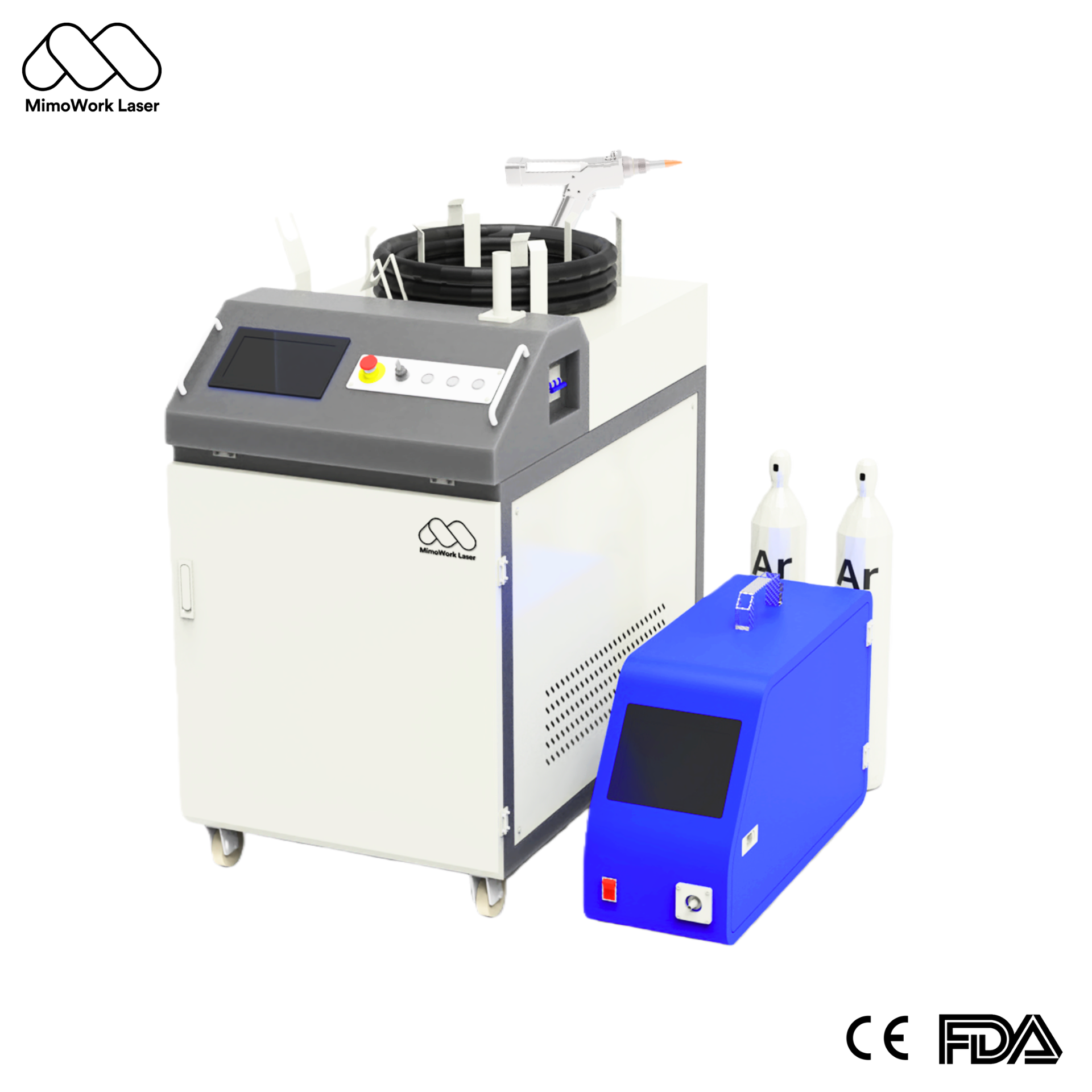
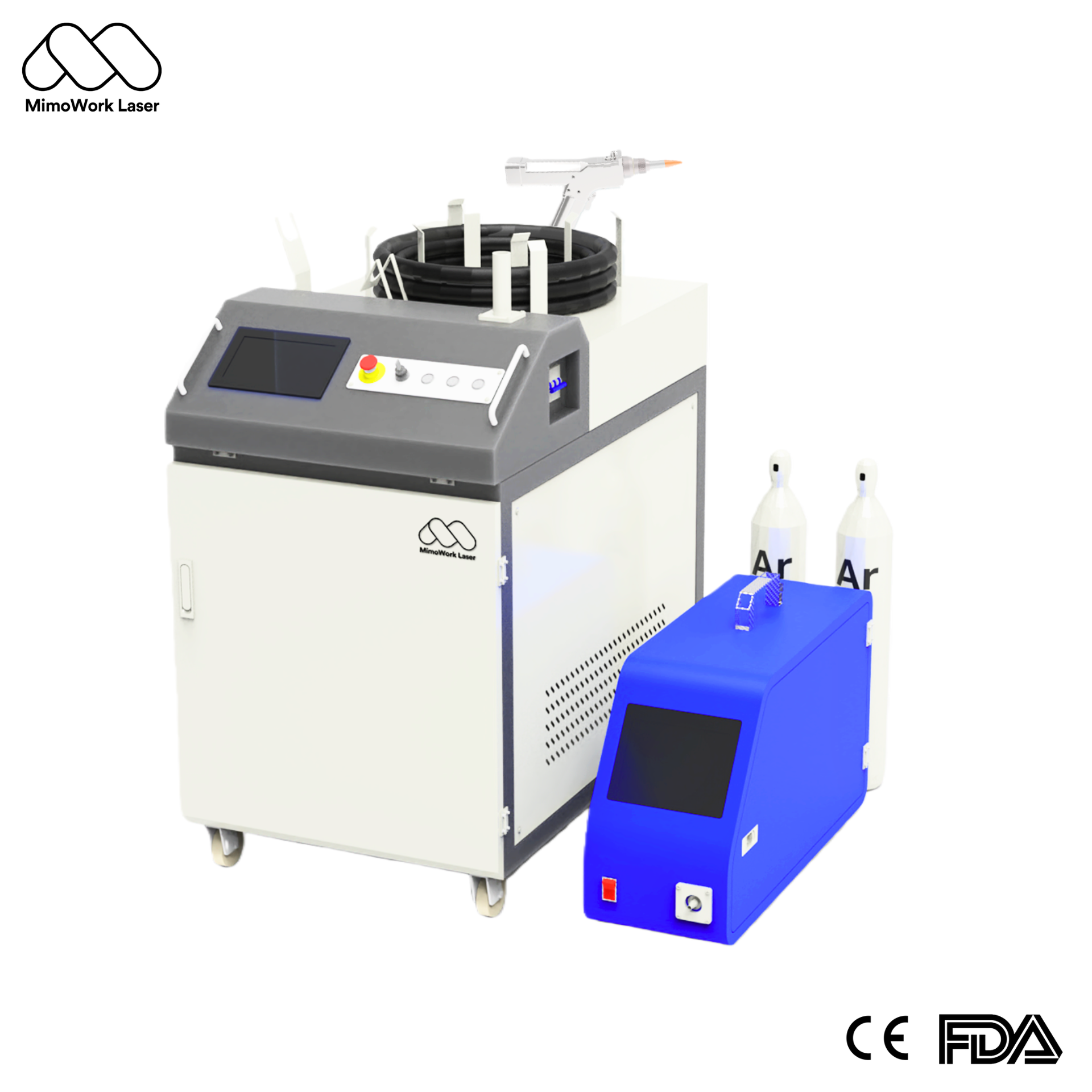
For businesses looking for a flexible solution across stainless steel fabrication jobs, MimoWork’s Handheld Laser Welding Machine is worth considering. The system is available in configurations from 500W to 3000W, giving manufacturers different power levels to match the thickness and production requirements of their workpieces. MimoWork also documents stainless steel as one of the supported materials for its handheld laser welding systems.
For lighter stainless-steel work and general fabrication, a lower-power configuration can be considered when the material thickness and required penetration fall within its processing range. For thicker material or higher production requirements, higher-power configurations provide more processing capacity. MimoWork’s published reference information includes 1000W, 1500W, 2000W, and 3000W configurations for stainless steel applications, with the appropriate setting depending on material thickness and process conditions.
The important point is not to select the highest available power simply because it offers more output. A stainless-steel fabricator should first establish the typical material thickness, joint design, required weld quality, and daily workload, then select the laser welding configuration that fits those requirements. This makes the equipment decision more closely aligned with actual production rather than maximum machine specifications.
Related Guide:What is Precision Laser Welding? A Complete Guide to Applications, Advantages, and Process
It depends on the application. Laser welding can be advantageous for repeatable production, concentrated heat input, and automation, while TIG can be preferable when manual control, joint flexibility, or lower-volume work is more important.
It can be provided the process parameters, joint design, shielding, and material handling are appropriate. Thin material requires careful control of heat input.
No welding process should be described as completely distortion-free. Laser welding can reduce thermal input and the affected area in suitable applications, which can help reduce distortion, but actual results depend on process conditions.
Laser welding generally benefits from accurate joint preparation and consistent fit-up. Poorly controlled gaps can reduce process stability and may require filler or a different process strategy.
MIG can offer higher deposition rates and faster production in many fabrication applications, although actual cycle time depends on the material, joint design, and welding parameters.
Not universally. Many factories will continue to use different welding processes for different products. Laser welding is best considered as another production technology that may be particularly valuable for precision and repeatable applications.
The decision between stainless laser welding, TIG, and MIG should be based on the entire manufacturing process.
Laser welding can be highly attractive when a manufacturer needs concentrated heat input, repeatability, automation, and reduced downstream finishing. TIG remains valuable where operator control and flexibility are central. MIG remains practical for many high-volume fabrication applications where deposition rate and versatility matter.
The key is not to ask which technology is universally superior.
Instead, identify the cost, quality, cycle-time, fit-up, and finishing requirements of the actual production part.
For manufacturers evaluating different production technologies, Laser Welding Machines should be assessed alongside the existing TIG or MIG process using real components and complete production-cycle measurements.
News | Sep-25-2026
News | Sep-18-2026
News | Aug-19-2026