Blog
In a field that evolves daily, staying ahead means staying informed.
Explore in-depth articles designed to help you solve complex challenges,
maximize your machine’s ROI.
Stay ahead in a competitive market.


In a field that evolves daily, staying ahead means staying informed.
Explore in-depth articles designed to help you solve complex challenges,
maximize your machine’s ROI.
Stay ahead in a competitive market.
News | Oct-17-2026 | Mimowork
Quick Answer
A continuous wave (CW) laser cleaning machine is generally better suited to removing heavy rust, thick contamination, or coatings from large, robust metal surfaces where productivity is a priority. A pulsed system is often preferable for precision components, molds, thin materials, and applications where controlling heat input is essential. The right choice depends on the contaminant, base material, surface tolerance, cleaning speed, and required finish—not simply the laser’s rated power.
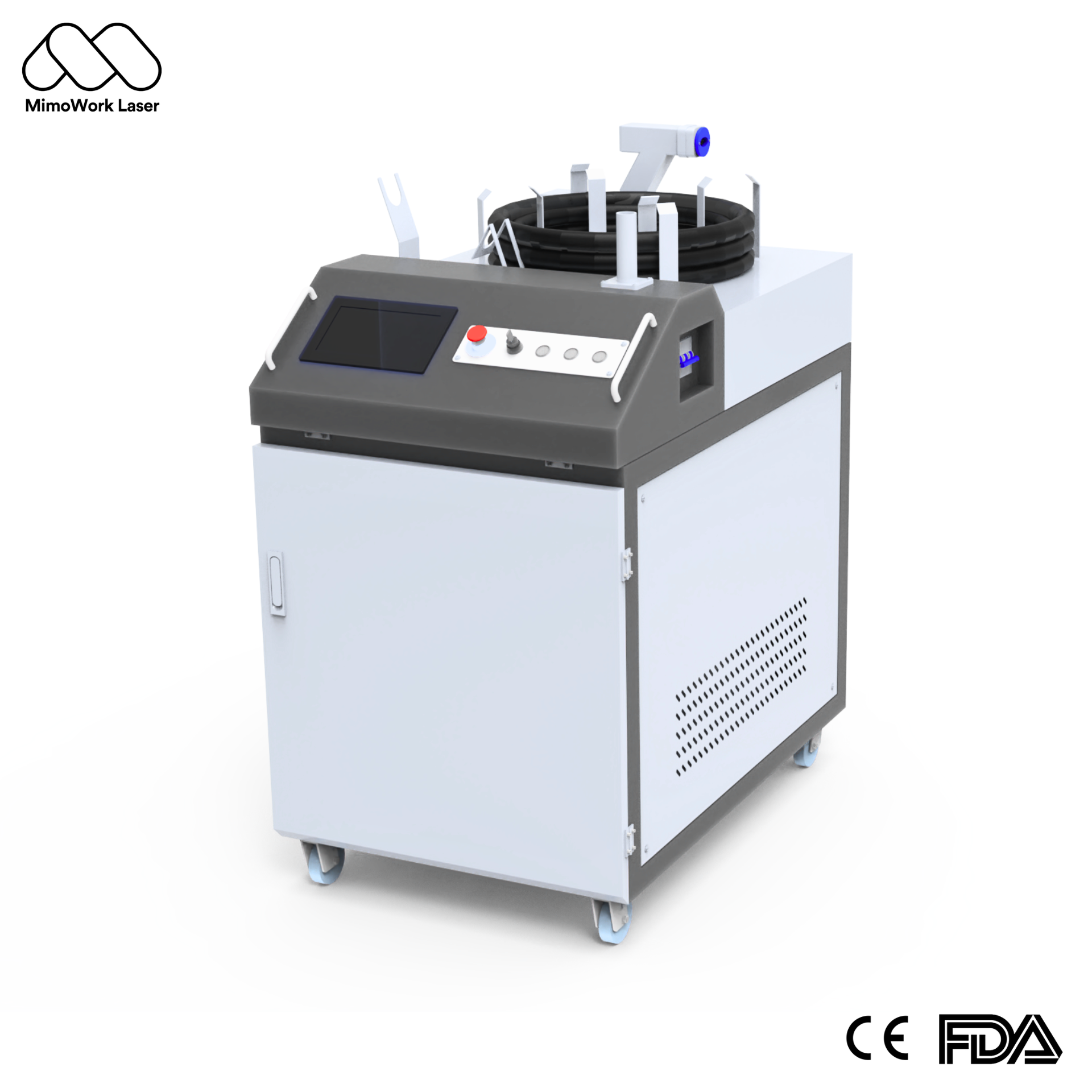
Removing rust or surface contamination from metal sounds straightforward until the material underneath must remain undamaged. A steel structure can tolerate a different cleaning process from a thin aluminum component, precision mold, or machined part with tight dimensional tolerances.
Traditional methods such as abrasive blasting and chemical cleaning can be effective, but they may introduce secondary waste, require additional handling, or affect the underlying surface. Laser cleaning offers an alternative by directing laser energy at unwanted surface layers, allowing contaminants to be removed through processes such as ablation, rapid heating, and thermal stress.
However, not all laser cleaning systems deliver energy in the same way. Continuous-wave and pulsed lasers have different energy-delivery characteristics, which influence cleaning speed, heat accumulation, process control, and suitability for particular workpieces.
Understanding these differences before purchasing equipment helps manufacturers avoid choosing a system that is unnecessarily expensive for their workload—or insufficiently precise for their application.
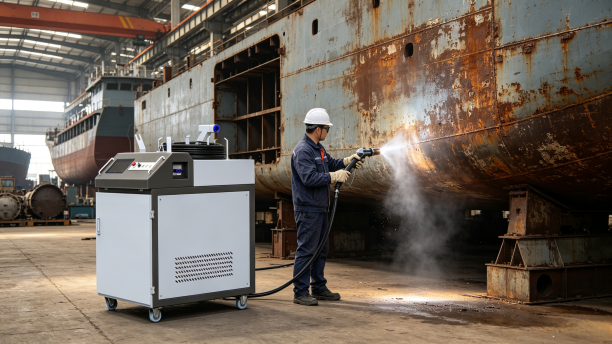
A continuous wave laser emits energy continuously while the beam is operating. In cleaning applications, this provides a sustained energy input that can be effective for removing substantial contamination from suitable metal surfaces.
CW systems are often considered for heavy rust removal, large steel structures, industrial equipment, and surface preparation before welding or coating. Their appeal is straightforward: when a large area needs to be cleaned and the substrate can tolerate the associated thermal input, continuous energy delivery can support high productivity.
The trade-off is heat accumulation. Energy that is not used to remove the contaminant can be transferred into the substrate. Depending on the material, thickness, scanning speed, and process settings, this may cause discoloration, unwanted surface changes, or thermal distortion.
That does not mean continuous lasers are inherently unsuitable for precision work. It means their process window must be evaluated carefully, particularly when cleaning thin sections, heat-sensitive components, or surfaces with strict dimensional requirements.
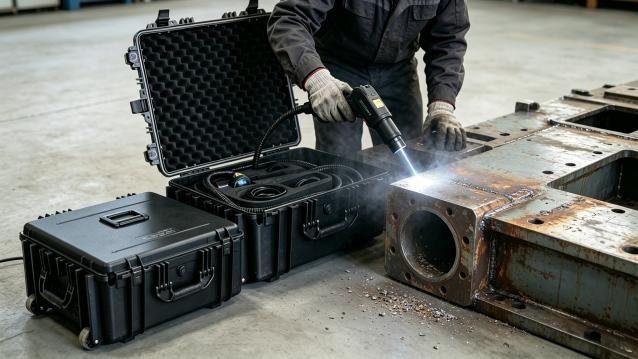
A pulsed laser releases energy in short bursts rather than maintaining a continuous output. Each pulse delivers energy over a defined duration, followed by an interval before the next pulse.
This approach allows the cleaning process to be adjusted around pulse energy, repetition frequency, scanning speed, and spot overlap. Properly configured, it can remove rust, oxide layers, paint, and other unwanted materials while limiting unnecessary heat transfer to the base metal.
Pulsed systems are commonly considered for precision tooling, injection molds, delicate metal components, localized contamination, and applications where the original surface finish must be preserved.
Their advantages do not eliminate the need for process control. Excessive pulse energy, poor focus, inappropriate overlap, or an unsuitable cleaning strategy can still damage the substrate. Moreover, a pulsed system is not automatically faster or more economical than a continuous system. The result depends on the cleaning task and the system’s actual operating characteristics.
| Comparison factor | Continuous-wave laser | Pulsed laser |
| Energy delivery | Continuous output | Short, repeated pulses |
| Main advantage | High productivity on suitable large surfaces | Controlled energy delivery for precision work |
| Heat accumulation | Can be higher under sustained exposure | Often lower at the substrate when appropriately configured |
| Heavy rust removal | Suitable for many robust metal surfaces | Suitable when controlled removal is more important than maximum coverage speed |
| Precision components | Requires careful thermal management | Often preferred for sensitive surfaces and tight tolerances |
| Large-area cleaning | Attractive for high-throughput operations | Can be suitable, depending on power and cleaning requirements |
| Typical applications | Structural steel, large metal parts, heavy contamination | Molds, precision parts, localized rust, selected coating-removal tasks |
| Important limitation | Excessive heat can alter the substrate | Process speed and cost depend on pulse characteristics and required coverage |
These are general tendencies, not absolute rules. High-power pulsed systems and lower-power continuous systems can behave very differently, so comparisons should be based on actual cleaning trials rather than laser type alone.
Consider a manufacturer preparing steel plates, large, welded assemblies, industrial frames, or metal structures before further processing. If rust or contamination covers a substantial area, the production challenge is often to achieve the required cleanliness without slowing the entire workflow.
A continuous system may be a practical choice when the workpiece is robust enough to tolerate the process, and the required cleaning quality can be maintained at an efficient scanning speed.
It can also be attractive for repetitive operations where large working areas and production throughput matter more than extremely localized treatment.
Before selecting a system, assess the thickness and thermal sensitivity of the workpiece. A thick steel plate and a thin metal sheet should not be treated as equivalent merely because both are made from metal.
Now consider an injection mold with intricate features, a machined component with tight tolerances, or a metal part where surface texture affects subsequent production.
In these cases, removing contamination is only part of the requirement. The cleaning process must also preserve the functional surface, avoid unnecessary heat exposure, and reach the target areas without changing the geometry.
A pulsed system is often the more appropriate starting point because its energy delivery can be adjusted for localized cleaning. This is particularly relevant when the value of the workpiece makes rework, replacement, or surface restoration expensive.
Pulsed cleaning may also be worth evaluating for thin materials, selected aluminum components, and parts that require careful treatment around edges or detailed features. Suitability must still be verified with representative samples.
The first question is not how powerful the laser should be. It is what needs to be removed.
Loose rust, tightly bonded oxide, oil residue, paint, and industrial coatings respond differently to laser energy. Their thickness, composition, adhesion, and condition influence the energy required and the cleaning strategy.
For example, a lightly oxidized steel component may be straightforward to clean, while a heavily corroded part with deep pitting may require more extensive treatment. Removing the visible rust does not restore metal that has already been lost through corrosion.
Define the required cleaning endpoint before comparing machines. The objective might be visible rust removal, preparation for welding, coating removal, or a specified surface condition.
The same cleaning parameters can produce different results on different substrates. Steel, aluminum, copper, and other metals differ in thermal conductivity, reflectivity, and their response to concentrated laser energy.
Thickness matters as well. A heavy steel component may dissipate heat differently from a thin sheet, and a polished metal surface may interact with the beam differently from a rough or oxidized one.
When the workpiece has strict dimensional or cosmetic requirements, evaluate the cleaned surface for discoloration, roughness, deformation, and any other relevant changes. Material compatibility should be established through testing rather than assumed from the material name alone.
Rated power is an important specification, but it does not describe the entire cleaning process.
For a continuous laser, average output power and scanning speed help determine how energy is distributed across the surface. For a pulsed laser, average power must be considered alongside pulse energy, repetition frequency, and pulse duration.
Pulse overlap also affects the result. If adjacent pulses or scan lines overlap too little, contamination may remain between treated areas. If overlap is excessive, processing time and accumulated heat may increase.
This is why a direct comparison between a 500 W pulsed machine and a 500 W continuous machine can be misleading. Equal rated power does not guarantee equal peak power, energy distribution, removal rate, or substrate temperature.
A useful evaluation compares both systems on the same representative workpiece, using the same cleanliness target and documented inspection criteria.
Some applications need only the removal of loose contamination. Others require a clean, uniform surface suitable for a subsequent coating, welding operation, or precision manufacturing process.
These are different objectives. A surface that looks clean to the eye may still contain residues or have a condition unsuitable for the next production stage.
If the part will be coated or bonded, confirm that the cleaning process produces the required surface condition. If it is a precision component, inspect critical dimensions and surface characteristics after cleaning.
The right system is the one that consistently achieves the required endpoint without creating an unacceptable secondary problem.
A higher removal rate does not always translate into higher overall productivity. Loading, positioning, operator handling, access to complex geometry, inspection, and rework can all affect production time.
For large, relatively simple surfaces, continuous cleaning may provide a practical advantage. For complex parts, a pulsed system may reduce the risk of damage and the time spent on corrective work.
A meaningful trial should record cleaning time per part or unit area, the quality of the result, operator handling requirements, and any additional finishing needed. This gives purchasing and production teams a more reliable basis for comparing alternatives.
| Application | Technology worth evaluating first | Main consideration |
| Heavy rust on thick steel plates | Continuous wave | Removal rate and heat tolerance |
| Rust on thin metal sheet | Pulsed | Limiting distortion and unwanted heat input |
| Injection mold cleaning | Pulsed | Preserving fine features and surface finish |
| Large welded steel structures | Continuous wave | Coverage speed and production throughput |
| Precision machined components | Pulsed | Dimensional and surface integrity |
| Paint removal from industrial metal parts | Either, depending on the coating and substrate | Removal efficiency and substrate protection |
| Localized oxide removal | Pulsed | Controlled treatment of selected areas |
| Large-scale surface preparation before coating | Continuous-wave or pulsed, depending on the required finish | Throughput, cleanliness target, and subsequent coating requirements |
This table is a starting point for equipment selection rather than a guarantee of performance. The actual coating, substrate, required cleanliness, and machine configuration can change which system performs best.
One frequent mistake is choosing a machine based entirely on rated wattage. Power is only one part of the process, and it cannot independently predict cleaning quality or substrate damage.
Another is assuming that the fastest visible rust removal represents the best result. If the process roughens a precision surface, causes discoloration, or leaves contamination in recessed areas, the apparent speed advantage may be offset by rework or rejection.
Buyers should also avoid treating every metal as equally compatible with a given laser. Reflectivity, thermal behavior, material thickness, and surface condition all influence the process.
Finally, do not overlook safety and extraction requirements. Laser cleaning can produce airborne particles, metal oxides, coating residues, and potentially hazardous fumes. The appropriate enclosure, extraction and filtration equipment, laser protective measures, and operating procedures should be determined through a task-specific risk assessment. Unknown coatings should be identified before processing, since their decomposition products may require additional controls.
Selecting a laser cleaning machine requires more than comparing rated power or choosing between continuous and pulsed output. Manufacturers also need to confirm that the equipment can remove the target contaminant while preserving the base material and meeting production requirements.
MimoWork takes an application-focused approach to laser equipment selection. The material, contaminant type, workpiece geometry, required cleaning result, and production workflow all help determine which configuration is worth evaluating.
Before investing in equipment, customers can submit representative materials for application testing. Testing can help assess rust or coating removal, surface changes, cleaning consistency, and the suitability of different process parameters. These results provide a more practical basis for evaluating equipment than general specifications alone.
For manufacturers comparing continuous and pulsed laser cleaning, representative trials can also help establish the balance between removal rate and substrate protection. The most suitable system is the one that achieves the required cleaning result consistently without introducing unacceptable surface damage or unnecessary processing time.
Related guide: How Much Does a Laser Cleaning Machine Cost? Industrial Price Guide
They can be used in some applications, but thin materials may be more vulnerable to heat accumulation and distortion. Test the actual material and thickness before committing to a production process.
Continuous-wave systems can be advantageous for large-area cleaning and high-throughput work. However, actual productivity depends on the contaminant, power, scanning strategy, workpiece geometry, and quality requirements. A representative cleaning trial is the most reliable way to compare performance.
Yes, laser cleaning can remove many types of paint and oxide, provided the laser and process are suitable for the coating and substrate. Different materials require different settings, and the coating’s composition should be assessed before processing.
Continuous-wave and pulsed laser cleaning solve overlapping but different industrial problems. Continuous output is often a practical choice for productive cleaning of large, robust metal surfaces. Pulsed output is frequently better suited to precision work where controlling heat input and protecting the substrate are priorities.
The most suitable laser cleaning machine for metal is not necessarily the most powerful or the fastest on paper. It is the system that removes the required contamination, preserves the workpiece to the necessary standard, and fits the real production workflow.
Before making a final decision, test both the cleaning result and the complete process on representative parts. This approach provides a more dependable basis for selecting equipment than rated power or general application claims alone.
JPT Laser, Do You Need a Continuous or Pulsed 500W Laser for Cleaning? Technical discussion of differences between CW and pulsed laser cleaning.
News | Sep-24-2026
News | Sep-4-2026