Blog
In a field that evolves daily, staying ahead means staying informed.
Explore in-depth articles designed to help you solve complex challenges,
maximize your machine’s ROI.
Stay ahead in a competitive market.


In a field that evolves daily, staying ahead means staying informed.
Explore in-depth articles designed to help you solve complex challenges,
maximize your machine’s ROI.
Stay ahead in a competitive market.
News | Nov-20-2026 | Mimowork
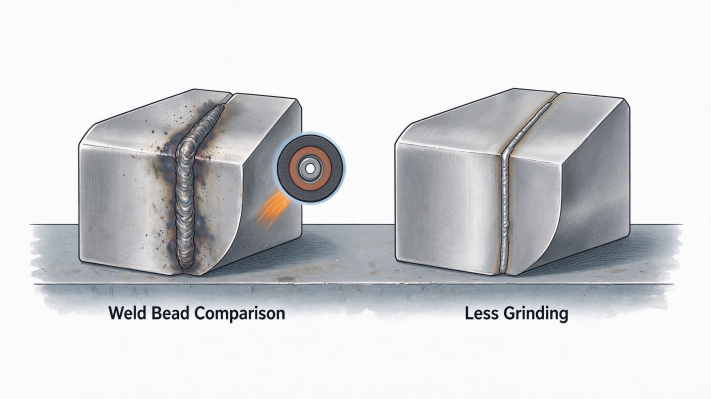
A metal welding laser can pay for itself surprisingly quickly—but usually not because the laser welds every joint dramatically faster.
The bigger opportunity is what happens after the weld.
Traditional welding can leave excess bead, spatter, discoloration, distortion, or an uneven surface that must be ground, brushed, polished, or repaired. A well-optimized laser welding process can produce a narrower, cleaner weld with less spatter and lower heat input, reducing the amount of downstream finishing required.
For a shop spending several hours every day grinding welded parts, the financial question is therefore not simply “How much faster is laser welding?”
It is:
“How much labor can I remove from the entire weld-to-finish process?”
The welding station is not necessarily where your production time disappears.
Consider a stainless-steel cabinet with 20 welded seams. The operator may finish the welding in a relatively short period, but the part still has to be cleaned, ground, blended, and sometimes polished before it can move to the next operation.
That creates a hidden second production line.
One employee welds. Another employee grinds. A third may polish the visible surface.
The weld itself may take minutes, while making the weld look finished takes much longer.
This is where a metal welding laser can change the economics. Laser energy is concentrated into a small area, which can produce a narrower and more controlled weld when the joint fit-up and parameters are appropriate. Less excess material and lower spatter can mean less material to remove afterward.
That distinction is important.
A manufacturer that compares only welding speed may underestimate the value of laser welding.
A manufacturer that compares welding + grinding + polishing + rework gets a much more realistic picture.
The easiest way to understand the business case is to stop looking at grinding as an unavoidable finishing step and calculate what it actually costs.
Suppose a fabrication shop welds 80 parts per day.
The welding itself takes 12 minutes per part. Post-weld grinding takes another 10 minutes.
80 × 10 minutes = 800 minutes per day
That is more than 13 labor hours every working day.
Even if only part of that labor can be eliminated, the financial impact becomes significant.
For example, assume a shop reduces average grinding time from 10 minutes to 3 minutes per part after optimizing a laser welding process.
That saves 7 minutes per part.
80 × 7 = 560 minutes saved per day
That is approximately 9.3 labor hours per day.
At a fully loaded labor cost of $30 per hour, the theoretical labor saving is about $280 per production day.
Over 22 working days, that becomes approximately $6,160 per month.
This does not mean every shop will achieve that result. It is an ROI model, not a guaranteed saving.
A laser welder does not need to replace every conventional welding operation to make financial sense. It only needs to remove enough expensive downstream labor.
The strongest business case is usually not a part that already comes out of the welding station looking finished.
It is a part that currently requires significant cosmetic finishing.
Stainless-steel enclosures are a good example. A weld may need to blend into the surrounding surface before polishing or brushing. A decorative metal frame may require grinding simply because the weld is visible. Furniture components can have the same problem.
In these applications, the weld is only the beginning of the labor.
A cleaner weld can reduce the amount of material that needs to be removed. Lower heat input can also help reduce distortion, which matters when a thin sheet needs to remain flat and dimensionally accurate. MimoWork positions its handheld system specifically around clean welding, lower heat input, and reduced post-processing.
The savings therefore come from several small improvements accumulating into one shorter production cycle.
Often, yes—but speed alone is the wrong comparison.
MimoWork states that its handheld laser welding solution can offer substantially higher welding efficiency than conventional arc welding in suitable applications.
But real production speed depends on material, thickness, joint geometry, gap size, filler wire, shielding gas, operator technique, and required penetration.
A laser weld that takes 30 seconds but requires five minutes of finishing is not necessarily better than a one-minute weld that needs almost no cleanup.
Total cycle time = setup + welding + grinding + polishing + inspection + rework
Laser welding becomes financially interesting when it reduces the entire equation.
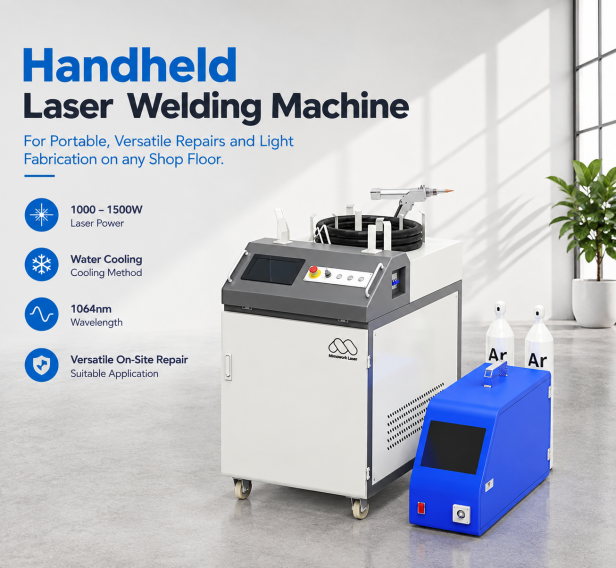
The most common applications include stainless steel, carbon steel, and aluminum. MimoWork’s current handheld configuration uses a 1000–1500W continuous/modulated fiber laser at 1064 nm and is positioned for steel, aluminum, and copper-alloy applications.
The important point is that material compatibility does not mean one parameter works across every job.
Aluminum, for example, behaves differently from stainless steel because of its thermal and optical properties. Joint geometry also changes the required process window.
This is why a supplier’s material list should never be the final purchasing criterion.
A sample weld using your actual alloy and thickness is far more useful.
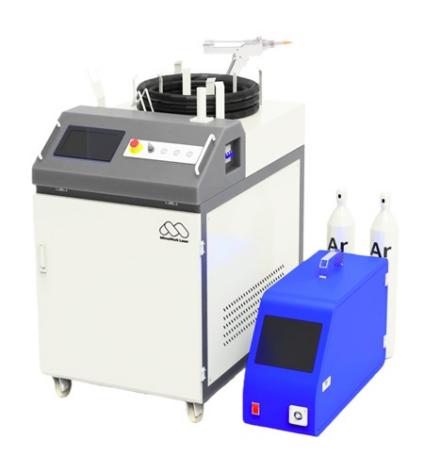
Buy enough power for your production range—not the highest number on the specification sheet.
For many handheld applications, 1000W–1500W is a practical range to investigate. MimoWork currently offers its handheld system in this range.
Power selection should be based on the thickest material you regularly weld, required penetration, joint configuration, welding speed, and whether filler wire is needed.
For example, a shop primarily welding thin stainless-steel sheet may gain more from precise process control than from purchasing a dramatically higher-power system.
Conversely, a fabricator regularly welding thicker carbon steel may need additional power to maintain penetration and production speed.
The mistake is treating wattage as a quality rating.
It is better understood as available processing headroom.
The answer becomes clearer when you compare two very different workshops.
A repair shop that welds five irregular parts per week may not have enough repetitive volume to justify replacing a proven conventional process.
A fabrication shop producing hundreds of visible stainless-steel parts every month is a different story.
For the second shop, every extra minute of grinding is repeated hundreds or thousands of times.
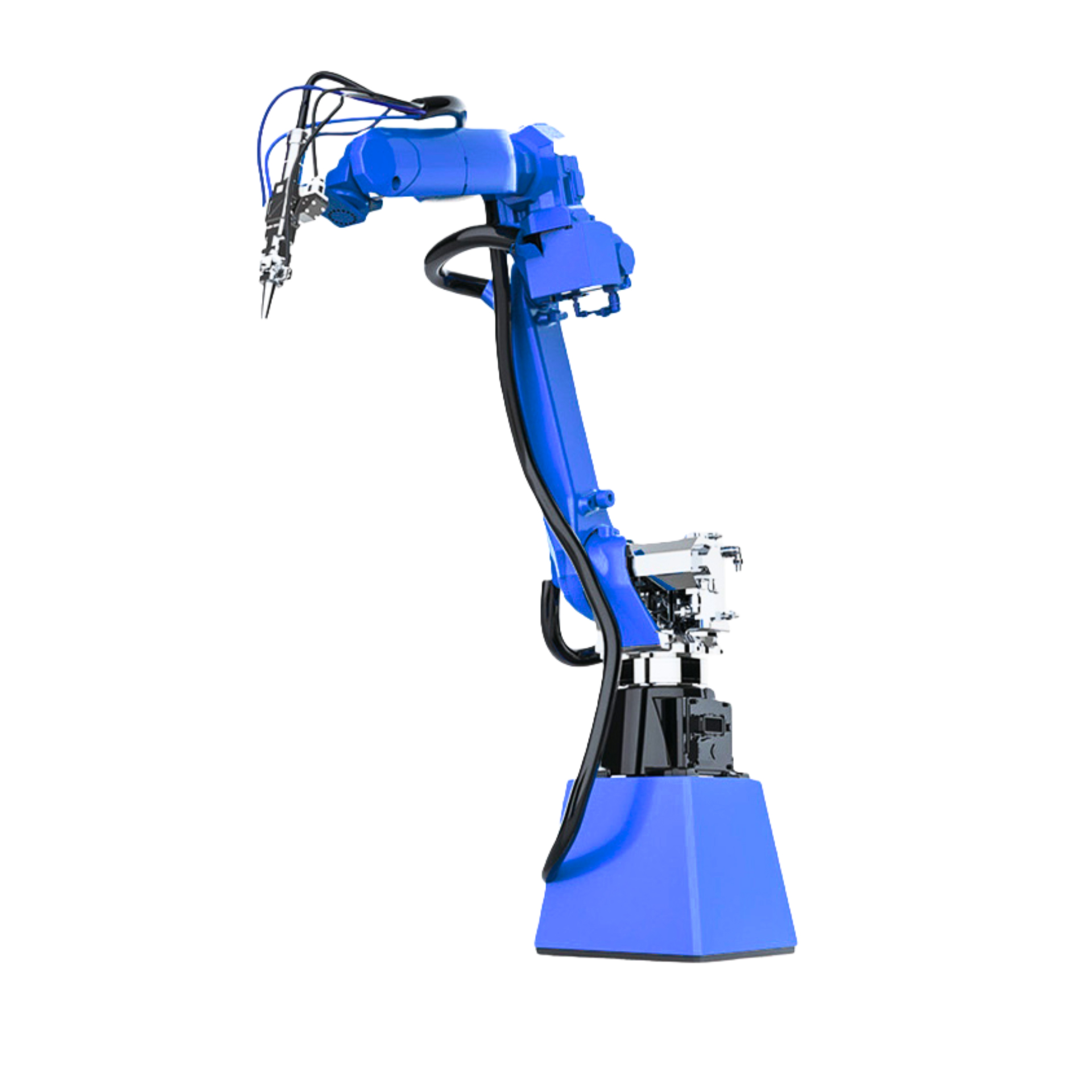
That is where a laser welding machine for metal can create leverage. MimoWork’s handheld system is designed for flexible fabrication and repair, while its broader welding range also includes automated 4-axis and robotic configurations for repetitive production.
In other words, the question is not whether laser welding is technically superior.
The question is whether your production contains enough repeatable labor waste for laser technology to remove it.
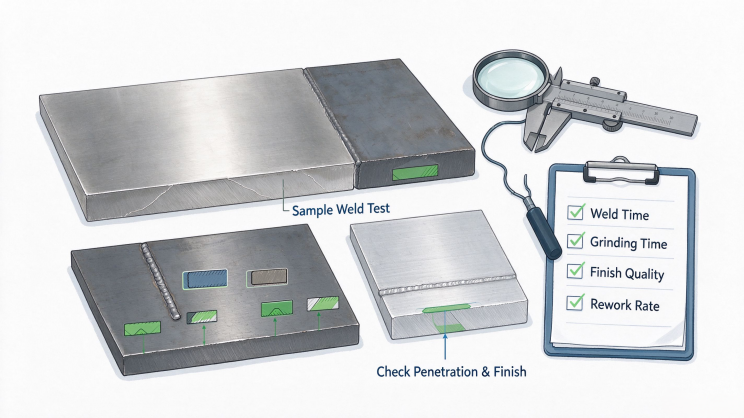
Don’t ask a supplier for a demonstration on a piece of generic stainless steel and assume the result will translate to your production line.
Bring the actual problem.
Give the supplier the metal alloy, thickness, joint type, typical gap, filler wire requirements, and your current welding process.
The most revealing test is often the last one.
A weld that looks excellent immediately after laser processing but fails dimensional or penetration requirements is not a successful production process.
MimoWork also provides application testing and parameter guidance for different welding materials and configurations. Its current handheld system includes an integrated wire feeder, while its MimoFUSE control platform is designed around welding controls such as pulse management, gas optimization, and real-time output monitoring.
No—and claiming otherwise would be misleading.
Some applications may require little or no post-weld grinding, but others will still need finishing because of joint design, cosmetic requirements, fit-up, filler material, or the required surface specification.
The more realistic expectation is less grinding, not zero grinding.
That distinction should also be part of your ROI calculation.
If your current process requires eight minutes of grinding and laser welding reduces that to two minutes, you have already removed 75% of the finishing labor—even though grinding has not disappeared.
That is a much more credible way to evaluate the technology.
Yes. Stainless steel is one of the common applications for handheld fiber laser welding, particularly where clean visible seams and reduced finishing are valuable. Actual parameters depend on alloy, thickness, joint design, and surface condition.
The answer depends on total production cost. A laser system can have a higher initial investment, but reduced welding time, grinding, consumables, and rework can improve the economics for high-volume or labor-intensive applications.
It can replace MIG in many suitable applications, but not every welding job. Joint geometry, material thickness, required penetration, production volume, and accessibility all matter.
Not always. Tight-fitting joints may be welded autogenously, while larger gaps or specific weld profiles may require filler wire. MimoWork’s handheld system includes an integrated wire-feeding option.
For many fabrication businesses, the biggest advantage is not simply welding speed. It is the ability to produce a controlled weld with less spatter and reduced downstream finishing in suitable applications.
Before buying a metal welding laser, calculate how many labor hours disappear into grinding every month.
Take your average number of welded parts, multiply it by current grinding time, and compare that with the finishing time from a properly tested laser-welded sample.
That number is more valuable than any generic “2× faster” or “10× efficiency” claim.
A laser welder may pay for itself in six months.
It may take twelve months.
Or it may not make financial sense for your operation at all.
The difference is hidden in your current post-weld labor.
If grinding, polishing, distortion correction, and rework are consuming a significant portion of your production hours, that is exactly where laser welding deserves a serious calculation.
Want to know whether your shop can reach a six-month payback? Send MimoWork your typical metal thickness, joint type, monthly welded volume, and average grinding time per part. A real sample-welding test can compare your current weld-to-finish cycle against a laser process and give you a much more useful basis for the investment decision.
Related guide: Can You Laser Weld Galvanized Steel?
News | Oct-20-2026