Blog
In a field that evolves daily, staying ahead means staying informed.
Explore in-depth articles designed to help you solve complex challenges,
maximize your machine’s ROI.
Stay ahead in a competitive market.


In a field that evolves daily, staying ahead means staying informed.
Explore in-depth articles designed to help you solve complex challenges,
maximize your machine’s ROI.
Stay ahead in a competitive market.
News | Nov-20-2026 | Mimowork
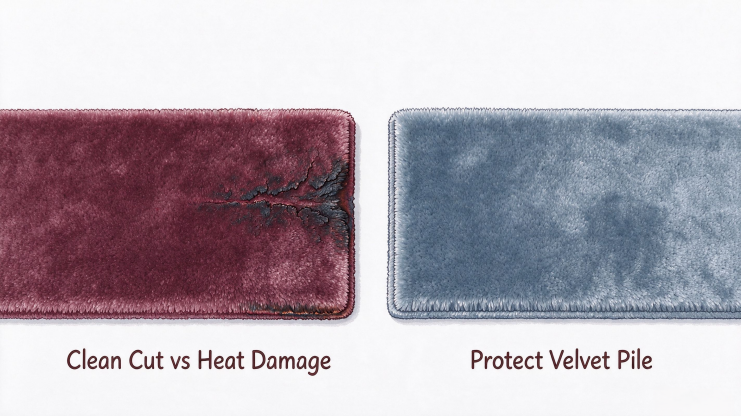
The best CO2 laser cutter for velvet is not necessarily the machine with the highest wattage.
Velvet is difficult because of its pile, not because it is difficult to cut.
A laser can produce a highly accurate cut, but too much heat can flatten the pile, change the surface color, create a hard melted edge, or leave visible marks around the cutting path.
For synthetic velvet, controlled laser cutting can produce a clean, sealed edge. Cotton velvet behaves differently because natural fibers do not melt and fuse in the same way.
That makes fiber composition, pile structure, cutting speed, and heat control more important than simply choosing a high-power machine.
Yes—but the cutting process has to protect the surface around the cut, not just penetrate the fabric.
Velvet is a pile fabric. Its visual quality comes from the raised fibers that create its characteristic direction, softness, and light reflection.
That creates an unusual laser-cutting problem.
A cut can be dimensionally perfect and still be a poor production result if the surrounding pile has been scorched or flattened.
Research on CO₂ laser treatment of velvet has shown that laser exposure can intentionally modify pile height and surface structure. That same sensitivity is useful for decorative engraving, but it also explains why cutting parameters need to be tightly controlled.
For commercial velvet products, the objective should therefore be:
cut the base material while disturbing as little of the surrounding pile as possible.
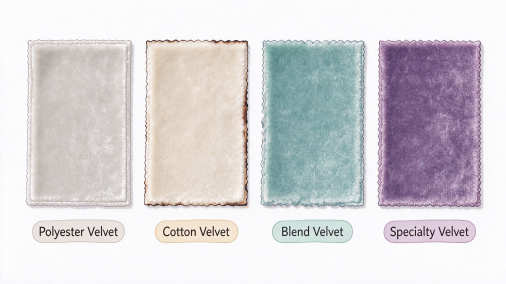
Synthetic velvet is generally easier to process for sealed edges because thermoplastic fibers can soften and fuse under heat.
Velvet is a construction rather than a single fiber type. Polyester velvet, cotton velvet, blended velvet, and specialty velvet can respond very differently.
| Velvet type | Laser behavior | Main production concern |
| Polyester velvet | Synthetic fibers can soften/fuse | Melted edge or heat band |
| Cotton velvet | Fibers char rather than melt | Scorching and fraying |
| Cotton/polyester blend | Mixed thermal behavior | Uneven edge response |
| Specialty/blended velvet | Highly variable | Requires material testing |
Recent research on CO₂ laser treatment of polyester-containing fabrics found that increasing laser intensity can cause fiber fusion and surface smoothing, while excessive laser exposure can reduce mechanical performance.
That is exactly why “more power” is not automatically better for velvet.
The goal is enough energy to make the cut—not enough energy to alter the surrounding fabric.
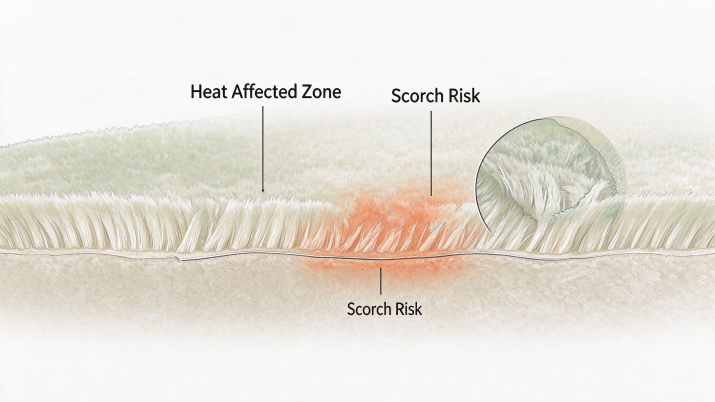
Most velvet problems come from excessive heat reaching the area beside the cutting line.
A slow, high-energy pass may successfully cut the fabric, but it can also create a wider thermal zone.
On polyester velvet, that can mean partially melted fibers or a shiny, hardened edge.
On cotton velvet, it can mean darkening or carbonization because the fibers do not behave like thermoplastic polyester.
The pile makes the problem more visible.
A small change in surface texture can reflect light differently from the surrounding velvet, creating a line that remains visible even when the cut itself is accurate.
This is why a production test should not be judged only by looking at the cut from directly above.
Run your hand across the pile, inspect the edge from an angle, and compare the color and texture several millimeters away from the cut.
Start by minimizing heat input, then increase energy only until the fabric reliably separates.
There is no universal “best” velvet setting.
Laser power, speed, focus, fabric weight, pile height, backing construction, and fiber composition all interact. Research on CO₂-treated textiles has repeatedly shown that changing laser intensity can alter surface morphology and fabric properties.
For synthetic velvet, the useful processing window is often relatively narrow: too little energy leaves incomplete cuts, while too much energy produces excessive melting.
For cotton velvet, the goal is different. Since the fibers are not being thermally sealed in the same way, edge appearance and post-cut finishing become more important.
This is why copying a parameter from another velvet supplier’s machine is rarely a reliable production strategy.
The same nominal fabric weight can have different pile height, backing, dye, and fiber composition.
For intricate patterns and repeatable digital production, a laser has a major advantage: there is no mechanical cutting force pulling against the fabric.
A blade physically contacts the textile. Soft velvet can compress, shift, or stretch around the cutting path, especially when working with detailed shapes.
A CO₂ laser processes without direct mechanical contact. That makes it particularly useful for complex decorative outlines, repeated patterns, garment components, and customized textile designs.
There is another interesting application.
CO₂ laser treatment can deliberately modify velvet pile height to create surface patterns. Research from North Carolina State University demonstrated laser modification of cotton velvet pile height before digital printing, showing that laser treatment can change the surface characteristics of the pile itself.
So the laser does not have to be limited to “cutting velvet.”
It can become part of the textile design process.
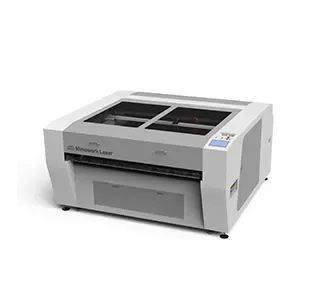
For occasional panels and small batches, a flatbed machine can be sufficient. For continuous fabric production, material handling becomes more important than simply increasing laser power.
A small workshop cutting individual velvet pieces may benefit from a compact or mid-size flatbed system.
As the material moves into roll-based apparel, upholstery, or larger textile production, the machine needs to keep fabric flat and feed it consistently. A conveyor system becomes much more valuable in that environment.
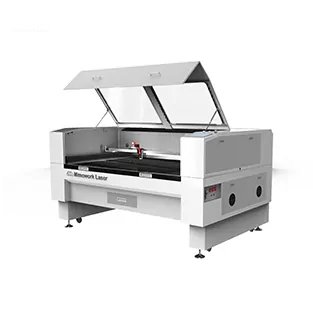
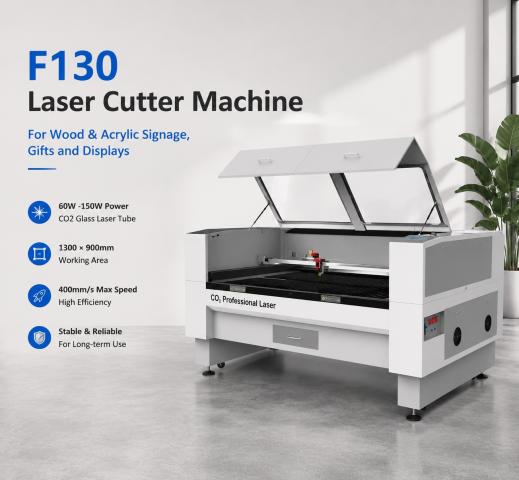
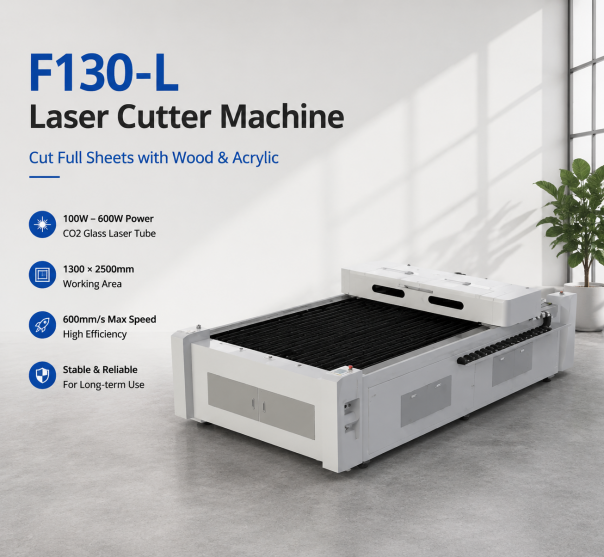
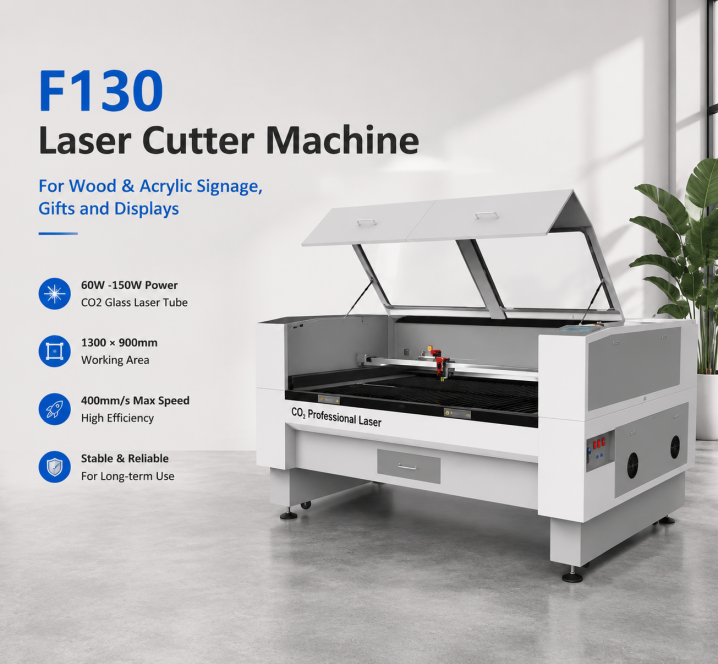
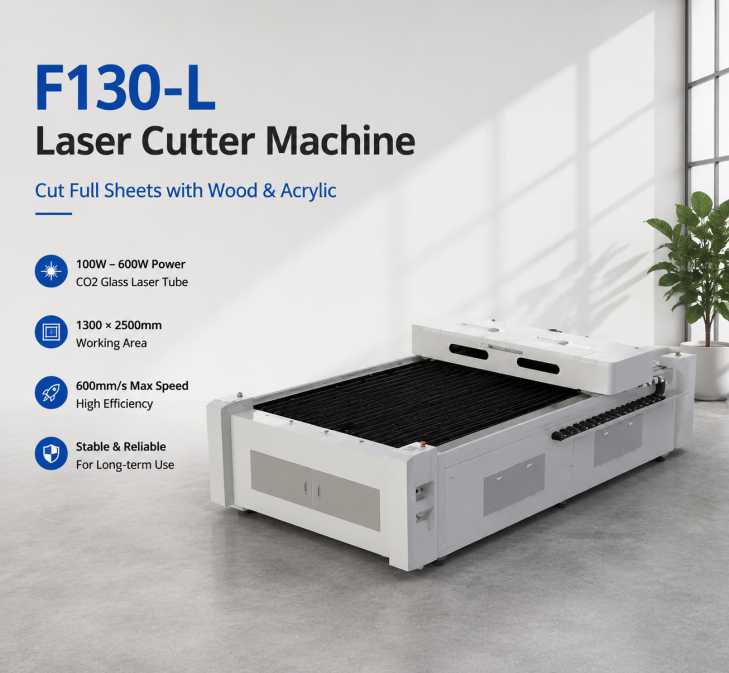
MimoWork’s F160 is designed for fabric and apparel cutting with a 1,600 × 1,000 mm working area and 100W–300W laser options. For industrial textile production, the F180-L is configured for continuous material handling and offers 150W–600W options with a large working area.
The choice should follow the workflow.
A higher-power machine is useful when throughput is the constraint. A conveyor system is useful when continuous fabric handling is the constraint. A vision system becomes valuable when the velvet contains printed or patterned graphics that need registered cutting.
Don’t judge it by the cleanest-looking sample. Judge it by repeated production.
A good sample can hide problems that appear after hundreds of cuts.
Before purchasing, run a production-style test with your actual velvet roll.
Measure the cut time, inspect the pile, check edge hardness, and repeat the same design several times.
Then change the fabric orientation and test again.
This matters because velvet has a visible pile direction. A cutting process that looks excellent in one orientation may produce a noticeably different appearance when the material direction changes.
For larger textile operations, also test how the machine handles continuous feeding. Fabric movement, vacuum holding, edge guidance, and registration accuracy can have a bigger impact on productivity than another 50W of laser power.
Yes. Fabric cutting creates airborne contaminants, so extraction should be treated as part of the laser system—not an optional accessory.
NIOSH research on CO₂ laser cutting of fabrics and polymers identified particulate matter and a range of gaseous and volatile compounds during laser processing. The study also found that local exhaust ventilation could effectively contain airborne contaminants outside the laser enclosure.
OSHA likewise recommends adequate ventilation for fumes and vapors generated during laser cutting and other target interactions.
This becomes particularly important when the velvet contains synthetic fibers, coatings, adhesives, or unknown finishes.
Never assume a textile is laser-safe simply because it looks similar to another fabric.
Material composition should be verified before processing.
The actual velvet you plan to manufacture with.
Can the machine cut through the backing completely?
Does the edge remain visually acceptable?
Is the pile around the cut still soft and consistent?
Can the result be repeated at production speed?
For a garment manufacturer, that may mean testing a complete pattern.
For an upholstery company, it may mean testing a large panel.
For a decorative textile producer, it may mean testing both cutting and pile engraving.
MimoWork offers material testing and application support, which can be useful when velvet composition or production requirements fall outside standard textile applications.
Related guide: How to Laser Cut Fabric Without Fraying
Yes. CO₂ lasers can process many velvet fabrics, but the result depends strongly on fiber composition, pile structure, backing, and laser parameters.
Synthetic velvet may achieve a heat-sealed edge, but cotton velvet behaves differently. A universal fray-free claim should not be made without testing the actual fabric.
There is no universal wattage. Thin velvet may require relatively low energy, while thicker or dense textile constructions may require more. The best setting is the lowest energy that produces a complete, repeatable cut at the required production speed.
Yes. CO₂ laser treatment can modify pile height and surface appearance. Research has demonstrated controlled laser modification of velvet pile for textile design and printing applications.
It can. Excessive heat may melt synthetic fibers, flatten the pile, discolor the surface, or weaken the fabric. Testing should therefore evaluate the area around the cut, not only the cut line itself.
Choosing a laser for velvet is not really a race for the highest wattage.
Velvet rewards control.
A good cutting system produces an accurate edge without leaving a visible thermal signature around it. For polyester velvet, that may mean achieving a controlled sealed edge. For cotton velvet, it may mean accepting that edge sealing works differently and focusing more heavily on heat control and finishing.
For small production, a flatbed CO₂ laser may be enough.
For continuous apparel or upholstery production, a conveyor-based textile system can become much more valuable.
And for printed velvet, vision-assisted cutting may matter more than another increase in laser power.
Before buying, test your actual fabric at the production speed you need. Look beyond whether the machine cuts through the material. The real test is whether the velvet still looks and feels like velvet after it has been cut.
National Institute for Occupational Safety and Health (NIOSH/CDC), Laser Generated Air Contaminants Released During Laser Cutting of Fabrics and Polymer. NIOSH / CDC research record
Occupational Safety and Health Administration (OSHA), Guidelines for Laser Safety and Hazard Assessment. OSHA laser safety guidance
News | Nov-15-2026