Blog
In a field that evolves daily, staying ahead means staying informed.
Explore in-depth articles designed to help you solve complex challenges,
maximize your machine’s ROI.
Stay ahead in a competitive market.


In a field that evolves daily, staying ahead means staying informed.
Explore in-depth articles designed to help you solve complex challenges,
maximize your machine’s ROI.
Stay ahead in a competitive market.
News | Nov-14-2026 | Mimowork
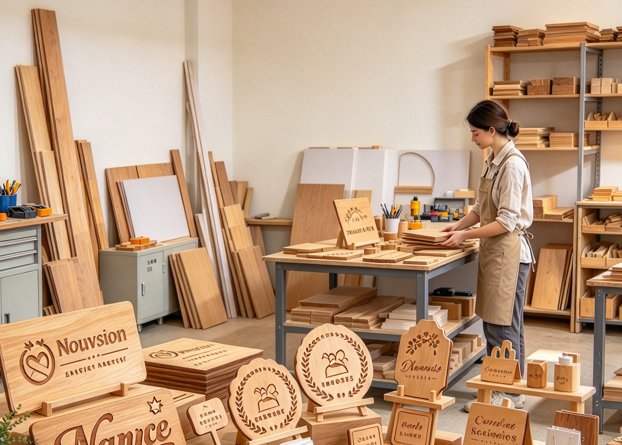
Wood is one of the most common materials for laser engraving, but choosing a suitable machine involves more than testing whether it can produce a visible mark. For commercial buyers, engraving consistency, material compatibility, and production efficiency matter more than an impressive sample produced during a demonstration.
CO2 laser technology is widely used for wood engraving because it can reproduce detailed patterns, text, and graphics across different wooden materials. However, wood density, moisture, grain direction, and surface treatments all influence the final result.
When comparing wood laser etching machines, buyers should pay attention to the machine platform, motion stability, optical components, and fume extraction rather than focusing exclusively on laser power.
CO2 lasers are suitable for detailed wood engraving and a wide range of wooden products.
Wood density, grain direction, and moisture content influence engraving results.
Working area, motion stability, and focus control affect production consistency.
Effective cooling and fume extraction are essential for stable operation.
Testing actual materials is more reliable than relying on standard machine demonstrations.
CO2 lasers are a practical choice for commercial wood engraving because they can produce detailed surface marks without mechanical contact with the material.
At a wavelength of 10.6 microns, the laser beam generates heat on the wood surface, creating darker engraved areas by removing or charring material. Engraving depth and appearance vary according to the material and processing conditions.
For production workshops, this technology offers several advantages:
For businesses producing wooden gifts, decorative items, signage, and furniture details, a CO2 laser engraver for wood provides a flexible solution for different engraving requirements.
Wood consistency is one of the main challenges in laser engraving. Two boards with identical nominal thicknesses can produce noticeably different results because their internal structures are not necessarily the same.
Adhesives and surface coatings: Plywood and MDF contain binding resins, while coated panels may include additional surface treatments. These materials can influence engraving appearance and smoke generation.
Research published in BioResources on gas-assisted laser processing of cherry wood also demonstrates how wood microstructure can affect processing quality.
For manufacturers, testing representative samples is therefore essential. Machine settings that work well on one wooden board should not automatically be applied to another material.
The most important purchasing considerations are working area, motion stability, focus control, and extraction performance. These factors have a direct impact on engraving quality and daily production.For projects focused on small, repeatable identification marks rather than larger decorative designs, buyers may also consider a Laser Marking Machine. Before choosing, compare its marking area, supported wood materials, and compatibility with the intended engraving patterns.
| Evaluation Factor | What to Verify | Why It Matters |
| Laser power | Compatibility with the wood materials being engraved | Influences engraving depth and processing efficiency |
| Working area | Dimensions of regular workpieces | Determines production flexibility |
| Motion system | Positioning accuracy and repeatability | Maintains consistent engraving details |
| Focus and optics | Focus adjustment and lens condition | Helps maintain engraving quality |
| Fume extraction | Airflow and extraction coverage | Removes smoke and processing residue |
| Cooling system | Appropriate water-cooling configuration | Supports stable laser operation |
Yes. The working area determines how many products can be arranged and processed in one setup.
A compact machine is suitable for small personalised products, while a larger platform provides more room for decorative panels and multiple engraving designs.
Buyers should consider their largest regular workpieces and typical batch sizes. An unnecessarily large machine may increase equipment costs without improving actual production efficiency.
Motion stability directly affects the accuracy of engraved patterns, particularly when processing fine text, detailed graphics, and repeated designs.
A belt-drive system may be suitable for certain compact applications, while larger platforms may benefit from servo motors and gear-rack transmission. Ball screw drives can also be useful where precise movement on smaller axes is important.
Rather than relying exclusively on brochure specifications, buyers should test their own design files and compare repeated engraving results.
Yes. Both systems are essential parts of a reliable CO2 laser engraving setup.
Water cooling helps maintain a stable operating temperature for the laser tube during extended production. Fume extraction removes smoke and airborne particles generated during engraving.
Insufficient extraction can leave smoke around the processing surface, affecting engraving appearance. Accumulated combustible residue can also create fire risks.
A suitable installation should include properly sized extraction ducting, regular filter maintenance, and appropriate machine monitoring.
Different wooden products require different engraving capabilities. The following applications illustrate where machine configuration and engraving consistency become important.
1. Personalised Wooden Products
Nameplates, gifts, keepsakes, and promotional items often involve frequent design changes and small production batches.
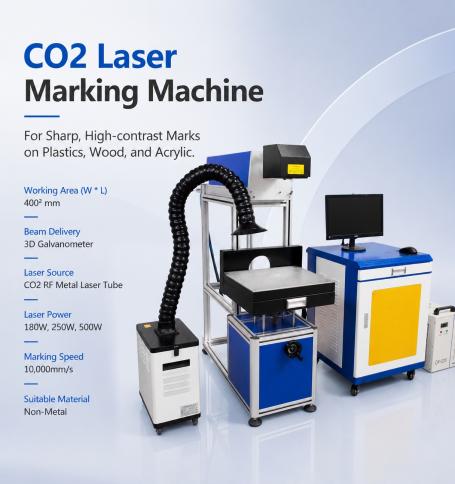
A galvo marker with a 400 × 400 mm working field can be considered for applications involving detailed graphics and variable-data marking. Its moving laser beam makes it suitable for fast marking applications where the workpiece remains stationary.
2. Decorative Products and Signage
Wall art, ornaments, patterned panels, and shop signs often combine engraved graphics with decorative outlines.
For these applications, working area and material arrangement influence how efficiently multiple designs can be processed in one batch.
3. Furniture Components
Wooden inlays, decorative inserts, and product labels require accurate positioning and consistent engraving.
For repeated production, maintaining the same engraving appearance across different components is more important than producing one particularly attractive sample.
4. Retail Displays and Packaging
Wooden fixtures, display structures, and packaging components frequently involve changing designs and relatively short production runs.
Digital design files make it easier to accommodate different patterns and branding requirements without additional engraving tooling.
A standard machine demonstration is not enough to establish whether equipment can meet commercial production requirements.
Buyers should provide representative wood samples and actual design files before making a final decision.
For unfamiliar materials, request the relevant safety data sheet from the supplier before processing. Adhesives, coatings, and binding resins may affect processing safety.
Excessive heat input, processing speed, focus position, and wood characteristics can all influence engraving darkness.
Resin-rich MDF and dense hardwoods may produce darker marks than softwood under identical settings. Adjusting speed and focus should be considered before increasing laser power.
Yes. Wood engraving generates smoke and airborne particles that need to be removed from the machine enclosure.
Proper extraction also helps reduce combustible residue accumulation. Regular filter maintenance and machine monitoring are important safety measures.
Yes. CO2 laser tubes require water cooling to maintain stable operating temperatures.
The cooling system and its installation space should be included when planning the complete machine setup.
The best wood laser engraving machine is one that matches your regular materials, product dimensions, and production volume.
The wood species and board construction you regularly process.
The largest workpiece required for engraving.
The smallest text or pattern details that must be reproduced.
Your expected production output and batch requirements.
MimoWork offers different CO2 laser machine configurations for wood engraving, from compact platforms for smaller products to larger working areas for more demanding production layouts.
Contact MimoWork to arrange a sample evaluation using your own wood materials and engraving designs. This provides a more practical basis for selecting a machine than comparing specifications alone.
2. Massachusetts Institute of Technology, Environment, Health and Safety. Laser Cutter Safety Guidance.
News | Nov-10-2026
News | Sep-4-2026
News | Sep-11-2026